Months of the Year in German
12 months of the year in German, Pronunciation, English and Hindi Meaning
Learning the months of the year in German is an important part of building everyday German vocabulary. Whether you are talking about your birthday, planning a holiday, discussing an appointment, or understanding a German calendar, knowing the German names of the months makes communication much easier.
The good news is that most German month names are quite similar to their English equivalents. However, their pronunciation and spelling can be slightly different. In this guide, you will learn all 12 months of the year in German with pronunciation, English meaning, Hindi translation, and simple example sentences.
Months of the Year in German
German has twelve months, just like English. German month names are nouns, so they are always written with a capital letter.
| No. | German Month | Pronunciation | English Translation | Hindi Translation |
|---|---|---|---|---|
| 1 | Januar | YAH-noo-ar | January | जनवरी |
| 2 | Februar | FAY-broo-ar | February | फ़रवरी |
| 3 | März | MAIRTS | March | मार्च |
| 4 | April | ah-PRIL | April | अप्रैल |
| 5 | Mai | MY | May | मई |
| 6 | Juni | YOO-nee | June | जून |
| 7 | Juli | YOO-lee | July | जुलाई |
| 8 | August | ow-GOOST | August | अगस्त |
| 9 | September | zehp-TEM-ber | September | सितंबर |
| 10 | Oktober | ok-TOH-ber | October | अक्टूबर |
| 11 | November | no-VEM-ber | November | नवंबर |
| 12 | Dezember | deh-TSEM-ber | December | दिसंबर |
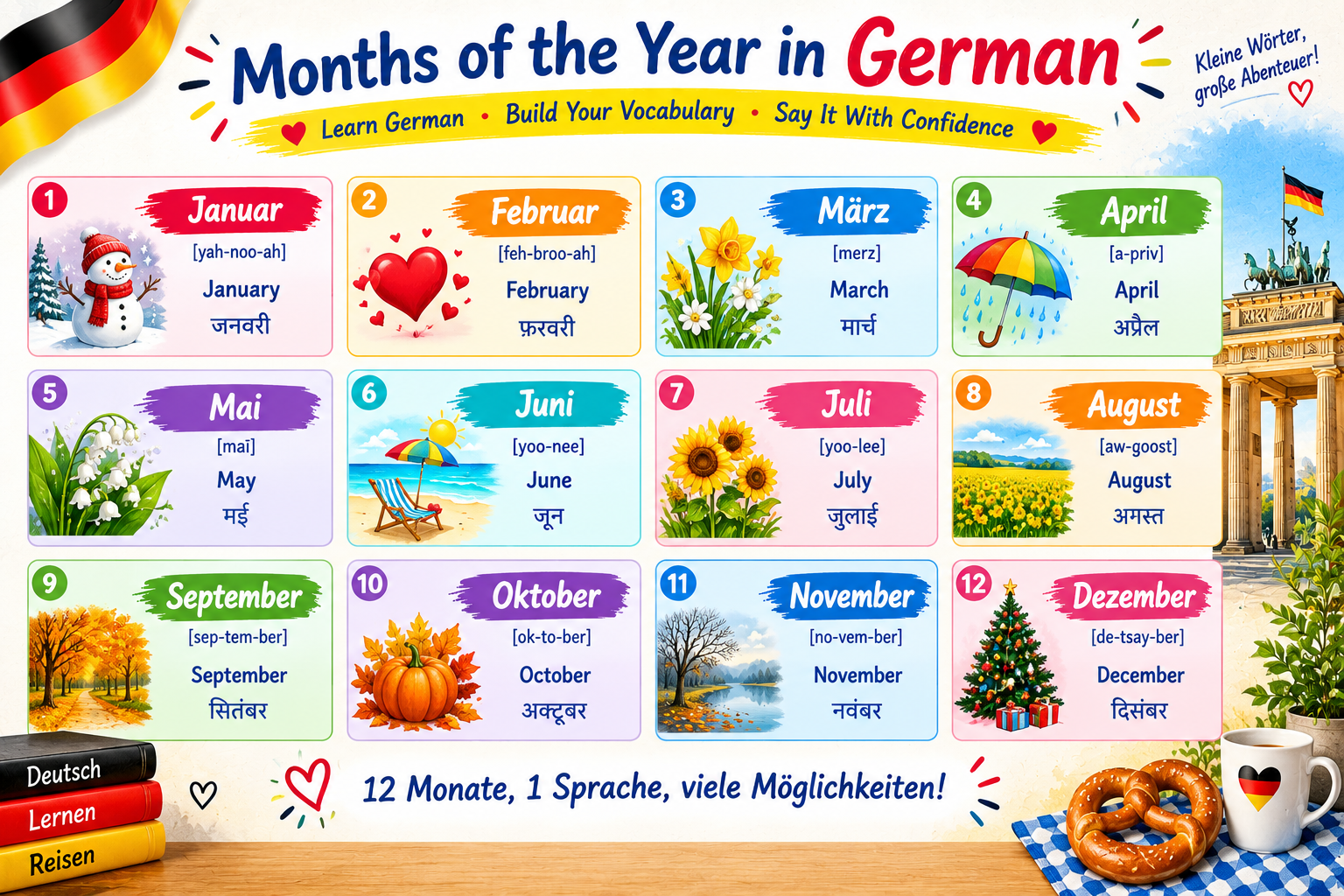
German Months Explained
Learning the months of the year in German becomes easier when you practice each month in a simple sentence. Let’s look at all twelve months individually.
1. Januar – January
Januar means January in English and जनवरी in Hindi. It is the first month of the year.
Example:
Im Januar ist es kalt.
It is cold in January.
The expression im Januar means “in January.” German commonly uses im before a month when describing something that happens during that month.
2. Februar – February
Februar means February and translates to फ़रवरी in Hindi. It is the second month of the year.
Example:
Mein Geburtstag ist im Februar.
My birthday is in February.
The pronunciation of Februar is slightly different from English, so beginners should practice saying it aloud.
3. März – March
März means March in English and मार्च in Hindi. The letter ä gives the word a distinct German pronunciation.
Example:
Im März beginnt der Frühling.
Spring begins in March.
Learning the spelling of März is important because it is different from the English word “March.”
4. April – April
April is the German word for April. It is written almost the same way as in English and translates to अप्रैल in Hindi.
Example:
Im April wird das Wetter wärmer.
The weather becomes warmer in April.
Because the spelling is familiar, April is usually easy for English speakers to remember.
5. Mai – May
Mai means May and translates to मई in Hindi. Unlike English, the German word is spelled with an i at the end.
Example:
Im Mai sind die Tage länger.
The days are longer in May.
Remembering the spelling Mai can help you avoid using the English spelling “May.”
6. Juni – June
Juni means June and translates to जून in Hindi.
Example:
Wir fahren im Juni nach Berlin.
We are traveling to Berlin in June.
The German pronunciation is approximately YOO-nee, rather than the English pronunciation of “June.”
7. Juli – July
Juli means July and translates to जुलाई in Hindi.
Example:
Im Juli mache ich Urlaub.
I go on vacation in July.
The words Juni and Juli can sometimes be confusing for beginners because they look and sound similar. Practice them together to remember the difference.
8. August – August
August means August and translates to अगस्त in Hindi.
Example:
Im August ist das Wetter oft warm.
The weather is often warm in August.
The German pronunciation is different from the common English pronunciation, so listening and speaking practice can be helpful.
9. September – September
September means September and translates to सितंबर in Hindi.
Example:
Die Schule beginnt im September.
School begins in September.
This month is easy to recognize because the German spelling is very similar to English.
10. Oktober – October
Oktober means October and translates to अक्टूबर in Hindi.
Example:
Im Oktober werden die Tage kürzer.
The days become shorter in October.
Notice that German uses Oktober, while English uses “October.”
11. November – November
November means November and translates to नवंबर in Hindi.
Example:
Im November ist es oft kühl.
It is often cool in November.
The spelling is nearly identical to English, which makes this month easy to remember.
12. Dezember – December
Dezember means December and translates to दिसंबर in Hindi. It is the final month of the year.
Example:
Im Dezember feiern viele Menschen Weihnachten.
Many people celebrate Christmas in December.
The German spelling uses z in Dezember, unlike the English spelling “December.”
How to Say Months in German
When talking about something happening in a particular month, German commonly uses the preposition im.
Here are some useful examples:
- im Januar — in January
- im Februar — in February
- im März — in March
- im April — in April
- im Mai — in May
- im Juni — in June
- im Juli — in July
- im August — in August
- im September — in September
- im Oktober — in October
- im November — in November
- im Dezember — in December
For example:
Ich reise im August nach Deutschland.
I am traveling to Germany in August.
The word im is a contraction of in dem and is commonly used with months.
Months and Seasons in German
Learning the months together with the four seasons can make German vocabulary easier to remember.
| Season | German | Common Months |
|---|---|---|
| Spring | der Frühling | März, April, Mai |
| Summer | der Sommer | Juni, Juli, August |
| Autumn | der Herbst | September, Oktober, November |
| Winter | der Winter | Dezember, Januar, Februar |
For example:
Im Sommer ist es warm.
It is warm in summer.
Im Winter ist es kalt.
It is cold in winter.
This connection between months and seasons can help you remember the calendar more naturally.
German Months with Articles
The months are masculine nouns in German, so they can be used with the article der when the article is required.
| German Month | With Article | English |
|---|---|---|
| Januar | der Januar | January |
| Februar | der Februar | February |
| März | der März | March |
| April | der April | April |
| Mai | der Mai | May |
| Juni | der Juni | June |
| Juli | der Juli | July |
| August | der August | August |
| September | der September | September |
| Oktober | der Oktober | October |
| November | der November | November |
| Dezember | der Dezember | December |
However, when saying “in January,” German normally uses im Januar rather than simply in der Januar.
How to Remember the Months of the Year in German
A simple way to memorize the months of the year in German is to learn them in groups of three or four.
Start with the first four:
Januar → Februar → März → April
Then learn:
Mai → Juni → Juli → August
Finally, practice:
September → Oktober → November → Dezember
You can also write the months on a German calendar and say them aloud every day. Connecting each month with a season, birthday, holiday, or personal event can make the vocabulary easier to remember.
Useful German Calendar Vocabulary
| German Word | Pronunciation | English | Hindi |
|---|---|---|---|
| der Monat | MOH-naht | month | महीना |
| die Monate | MOH-na-tuh | months | महीने |
| das Jahr | YAHR | year | वर्ष / साल |
| die Jahreszeit | YAH-res-tsite | season | ऋतु / मौसम |
| der Frühling | FROO-ling | spring | वसंत |
| der Sommer | ZOM-er | summer | गर्मी |
| der Herbst | HERPST | autumn | पतझड़ |
| der Winter | VIN-ter | winter | सर्दी |
| heute | HOY-tuh | today | आज |
| dieses Jahr | DEE-zes YAHR | this year | इस साल |
Example Sentences with German Months
Practicing complete sentences is an effective way to learn the months of the year in German.
| German Sentence | English Translation |
|---|---|
| Im Januar beginnt das neue Jahr. | The new year begins in January. |
| Mein Geburtstag ist im Februar. | My birthday is in February. |
| Im März beginnt der Frühling. | Spring begins in March. |
| Im April regnet es oft. | It often rains in April. |
| Im Mai ist das Wetter angenehm. | The weather is pleasant in May. |
| Im Juni beginnen die Sommerferien. | The summer vacation begins in June. |
| Im Juli fahre ich in den Urlaub. | I go on vacation in July. |
| Im August ist es warm. | It is warm in August. |
| Im September beginnt die Schule. | School begins in September. |
| Im Oktober fallen die Blätter. | The leaves fall in October. |
| Im November wird es kälter. | It gets colder in November. |
| Im Dezember feiern wir Weihnachten. | We celebrate Christmas in December. |
Months of the Year in German: Quick Revision
Here is a quick list of all twelve months for revision:
Januar — January
Februar — February
März — March
April — April
Mai — May
Juni — June
Juli — July
August — August
September — September
Oktober — October
November — November
Dezember — December
Remember that German month names begin with a capital letter because they are nouns.
Conclusion
Learning the months of the year in German gives beginners useful vocabulary for talking about birthdays, seasons, holidays, travel plans, school schedules, and important dates. The twelve months are Januar, Februar, März, April, Mai, Juni, Juli, August, September, Oktober, November, and Dezember.
To improve your German, practice the months in order and use im + month when talking about something happening during a particular month. Regular repetition and simple example sentences will help you remember both the spelling and pronunciation.
Frequently Asked Questions
1. How do you say January in German?
January is Januar in German.
2. How do you say February in German?
February is Februar in German.
3. How do you say March in German?
March is März in German.
4. How do you say April in German?
April is April in German.
5. How do you say May in German?
May is Mai in German.
6. How do you say June in German?
June is Juni in German.
7. How do you say July in German?
July is Juli in German.
8. How do you say August in German?
August is August in German.
9. How do you say September in German?
September is September in German.
10. How do you say October in German?
October is Oktober in German.
11. How do you say November in German?
November is November in German.
12. How do you say December in German?
December is Dezember in German.
13. How do you say months of the year in German?
“Months of the year” can be expressed as die Monate des Jahres in German.
14. How do you say month in German?
“Month” is der Monat in German.
15. How do you say months in German?
“Months” is die Monate in German.
16. What does “im Januar” mean in German?
Im Januar means “in January” in English.
17. Are German month names capitalized?
Yes. German month names are nouns and are therefore written with a capital letter, such as Januar, März, and Dezember.
18. What are the four seasons in German?
The four seasons are der Frühling for spring, der Sommer for summer, der Herbst for autumn, and der Winter for winter.
19. What is year in German?
“Year” is das Jahr in German.
20. What are the twelve months of the year in German?
The twelve months are Januar, Februar, März, April, Mai, Juni, Juli, August, September, Oktober, November, and Dezember.