Days of the Week in German
Days of the Week in German: Names, Pronunciation, English and Hindi Meaning
Learning the days of the week in German is one of the first steps toward building practical German vocabulary. These words are essential for talking about appointments, school, work, travel, schedules, and everyday activities.
In German, the days of the week are written with a capital letter because they are nouns. This article covers all seven days of the week in German with their pronunciation, English meaning, and Hindi translation. It also includes simple examples to help beginners use these German words naturally.
Days of the Week in German
The German names for the days of the week are relatively easy to learn because several of them have recognizable connections with English. However, their pronunciation differs, so beginners should practice both spelling and pronunciation.
| No. | German Day | Pronunciation | English Translation | Hindi Translation |
|---|---|---|---|---|
| 1 | Montag | MOHN-taak | Monday | सोमवार |
| 2 | Dienstag | DEENS-taak | Tuesday | मंगलवार |
| 3 | Mittwoch | MIT-vokh | Wednesday | बुधवार |
| 4 | Donnerstag | DON-ers-taak | Thursday | गुरुवार |
| 5 | Freitag | FRY-taak | Friday | शुक्रवार |
| 6 | Samstag | ZAHM-staak | Saturday | शनिवार |
| 7 | Sonntag | ZON-taak | Sunday | रविवार |
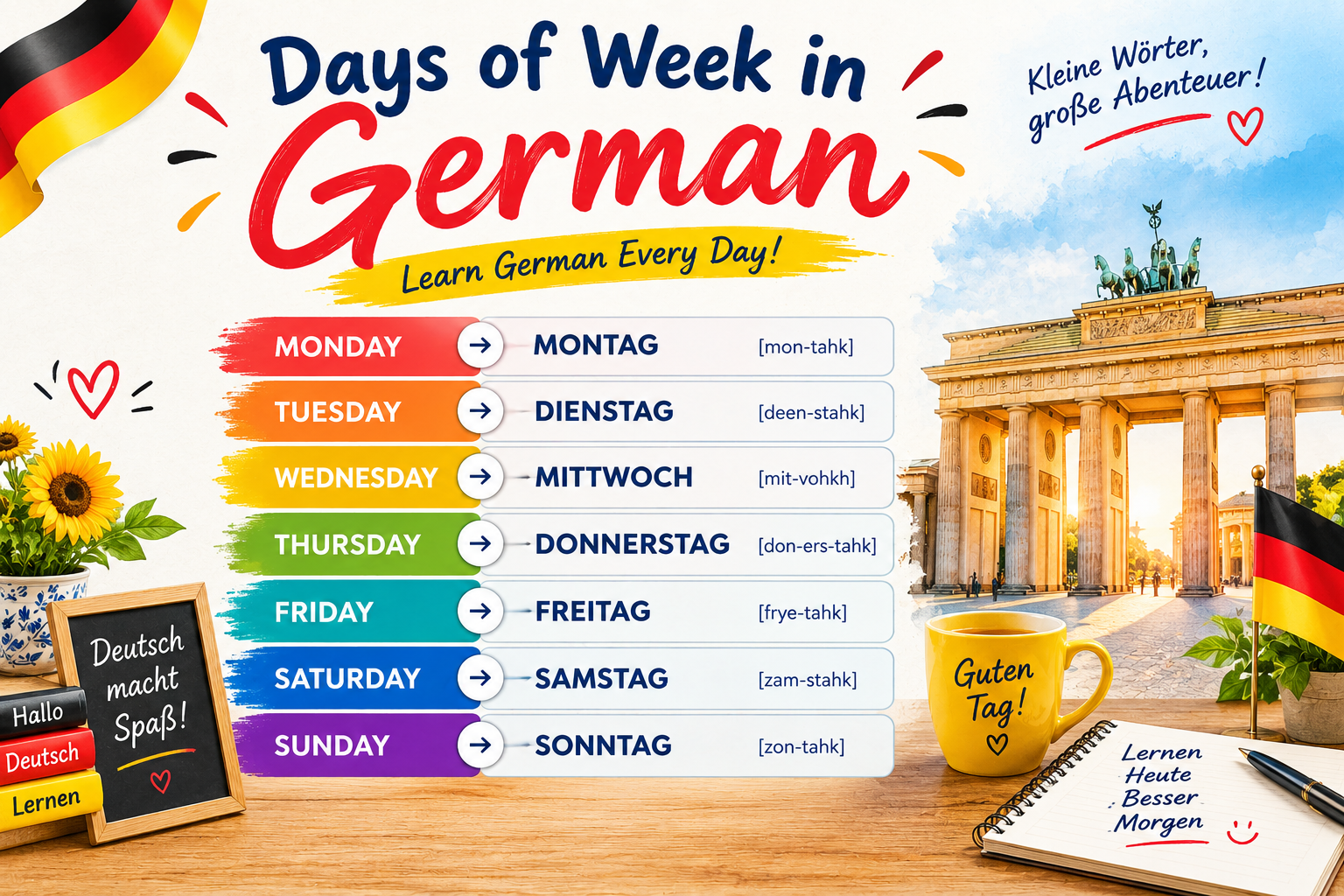
German Days of the Week Explained
Learning the days of the week in German becomes easier when you understand how each word is used in a simple sentence. Therefore, let’s look at each German day individually.
1. Montag – Monday
Montag means Monday in English and सोमवार in Hindi. It is the first day of the standard working week in Germany.
Example:
Am Montag arbeite ich.
I work on Monday.
मैं सोमवार को काम करता/करती हूँ।
The expression am Montag means “on Monday.” German commonly uses am before a day when talking about something happening on that day.
2. Dienstag – Tuesday
Dienstag means Tuesday and translates to मंगलवार in Hindi. It is another important word for everyday German conversations.
Example:
Am Dienstag habe ich Deutschunterricht.
I have German class on Tuesday.
मेरी मंगलवार को जर्मन की कक्षा है।
Using Dienstag in short sentences can help you remember the pronunciation and spelling more effectively.
3. Mittwoch – Wednesday
Mittwoch means Wednesday and translates to बुधवार in Hindi. The word is interesting because Mitte means “middle,” so Mittwoch literally refers to the middle of the week.
Example:
Am Mittwoch gehe ich zur Schule.
I go to school on Wednesday.
मैं बुधवार को स्कूल जाता/जाती हूँ।
Therefore, remembering the meaning behind Mittwoch can make this German day easier to memorize.
4. Donnerstag – Thursday
Donnerstag means Thursday in English and गुरुवार in Hindi. The word contains Donner, which means “thunder.”
Example:
Am Donnerstag habe ich einen Termin.
I have an appointment on Thursday.
मेरी गुरुवार को एक अपॉइंटमेंट है।
As a result, using the word in practical sentences makes the days of the week in German easier to remember.
5. Freitag – Friday
Freitag means Friday and translates to शुक्रवार in Hindi. It is commonly used when discussing weekend plans and work schedules.
Example:
Am Freitag treffe ich meine Freunde.
I meet my friends on Friday.
मैं शुक्रवार को अपने दोस्तों से मिलता/मिलती हूँ।
The word Freitag is particularly useful for conversations about plans because Friday often marks the beginning of the weekend for many people.
6. Samstag – Saturday
Samstag means Saturday and translates to शनिवार in Hindi. In many parts of Germany, Samstag is the common word for Saturday.
Example:
Am Samstag gehe ich einkaufen.
I go shopping on Saturday.
मैं शनिवार को खरीदारी करने जाता/जाती हूँ।
You may also encounter Sonnabend in some northern and eastern German-speaking regions. However, Samstag is widely understood.
7. Sonntag – Sunday
Sonntag means Sunday and translates to रविवार in Hindi. It is the final day of the conventional German week.
Example:
Am Sonntag bleibe ich zu Hause.
I stay at home on Sunday.
मैं रविवार को घर पर रहता/रहती हूँ।
The word Sonntag contains Sonne, meaning “sun,” which can provide a useful memory connection.
How to Use Days of the Week in German
Knowing the days of the week in German is useful, but learning how to use them in sentences is even more important. When you want to say “on Monday,” “on Tuesday,” or “on Sunday,” German generally uses am before the day.
For example:
- am Montag — on Monday
- am Dienstag — on Tuesday
- am Mittwoch — on Wednesday
- am Donnerstag — on Thursday
- am Freitag — on Friday
- am Samstag — on Saturday
- am Sonntag — on Sunday
Examples with German Days
Here are some simple sentences using the days of the week in German:
| German Sentence | English Translation |
|---|---|
| Am Montag lerne ich Deutsch. | I learn German on Monday. |
| Am Dienstag arbeite ich. | I work on Tuesday. |
| Am Mittwoch spiele ich Fußball. | I play football on Wednesday. |
| Am Donnerstag habe ich einen Termin. | I have an appointment on Thursday. |
| Am Freitag gehe ich ins Kino. | I go to the cinema on Friday. |
| Am Samstag besuche ich meine Familie. | I visit my family on Saturday. |
| Am Sonntag lese ich ein Buch. | I read a book on Sunday. |
Weekdays in German
The German word for “weekday” is der Wochentag. The plural form is die Wochentage. The seven days of the week in German form the basic vocabulary needed to discuss weekly schedules.
From Monday to Friday, you can use Montag, Dienstag, Mittwoch, Donnerstag, and Freitag. Saturday and Sunday are Samstag and Sonntag.
German Days and Their Articles
Unlike many other German nouns, the days of the week all use the masculine article der when used as nouns.
| German | English |
|---|---|
| der Montag | Monday |
| der Dienstag | Tuesday |
| der Mittwoch | Wednesday |
| der Donnerstag | Thursday |
| der Freitag | Friday |
| der Samstag | Saturday |
| der Sonntag | Sunday |
However, in everyday sentences, you will often see the form am Montag, am Dienstag, and so on.
How to Remember the Days of the Week in German
A simple way to memorize the days of the week in German is to learn them in order and practice them aloud every day.
Start with:
Montag → Dienstag → Mittwoch → Donnerstag → Freitag → Samstag → Sonntag
Next, create one sentence for each day. For example, connect Monday with studying, Tuesday with work, Wednesday with sports, and so on.
You can also write the German days on a weekly calendar. This approach combines visual learning with repetition and helps beginners remember German vocabulary more naturally.
German Days of the Week: Useful Vocabulary
Besides the seven days, several related German words are useful when discussing a weekly schedule.
| German Word | Pronunciation | English | Hindi |
|---|---|---|---|
| die Woche | VO-khuh | week | सप्ताह |
| die Woche | VO-khuh | week | सप्ताह |
| der Wochentag | VO-khen-taak | weekday | सप्ताह का दिन |
| das Wochenende | VO-khen-EN-duh | weekend | सप्ताहांत |
| heute | HOY-tuh | today | आज |
| morgen | MOR-gen | tomorrow | कल |
| gestern | GES-tern | yesterday | कल / बीता हुआ दिन |
| jeden Tag | YAY-den taak | every day | हर दिन |
These words work well with the days of the week in German and can help you create longer sentences.
Conclusion
Learning the days of the week in German is an important part of beginner German vocabulary. The seven days are Montag, Dienstag, Mittwoch, Donnerstag, Freitag, Samstag, and Sonntag.
To improve your German, practice these words regularly and use them in complete sentences. In addition, remember the common structure am + day, such as am Montag or am Sonntag. With regular practice, you can quickly become comfortable using the German days in everyday conversations.
Frequently Asked Questions
1. How to say Monday in German?
Monday is Montag in German.
2. How to say Tuesday in German?
Tuesday is Dienstag in German.
3. How to say Wednesday in German?
Wednesday is Mittwoch in German.
4. How to say Thursday in German?
Thursday is Donnerstag in German.
5. How to say Friday in German?
Friday is Freitag in German.
6. How to say Saturday in German?
Saturday is Samstag in German. In some German-speaking regions, Sonnabend is also used.
7. How to say Sunday in German?
Sunday is Sonntag in German.
8. How do you say days of the week in German?
“Days of the week” is die Wochentage in German.
9. How do you say week in German?
“Week” is die Woche in German.
10. How do you say weekend in German?
“Weekend” is das Wochenende in German.
11. What is Monday called in German?
Monday is called Montag in German.
12. What is Wednesday called in German?
Wednesday is called Mittwoch in German.
13. What is Friday called in German?
Friday is called Freitag in German.
14. What is Saturday called in German?
Saturday is called Samstag in German.
15. What is Sunday called in German?
Sunday is called Sonntag in German.
16. What does “am Montag” mean in German?
Am Montag means “on Monday” in English.
17. What does “am Wochenende” mean in German?
Am Wochenende means “on the weekend” in English.
18. Are German days of the week capitalized?
Yes. German days of the week are nouns, so they are written with a capital letter, such as Montag, Dienstag, and Sonntag.
19. What is weekday in German?
“Weekday” is der Wochentag in German, while the plural “weekdays” is die Wochentage.
20. What are the seven days of the week in German?
The seven days are Montag, Dienstag, Mittwoch, Donnerstag, Freitag, Samstag, and Sonntag.