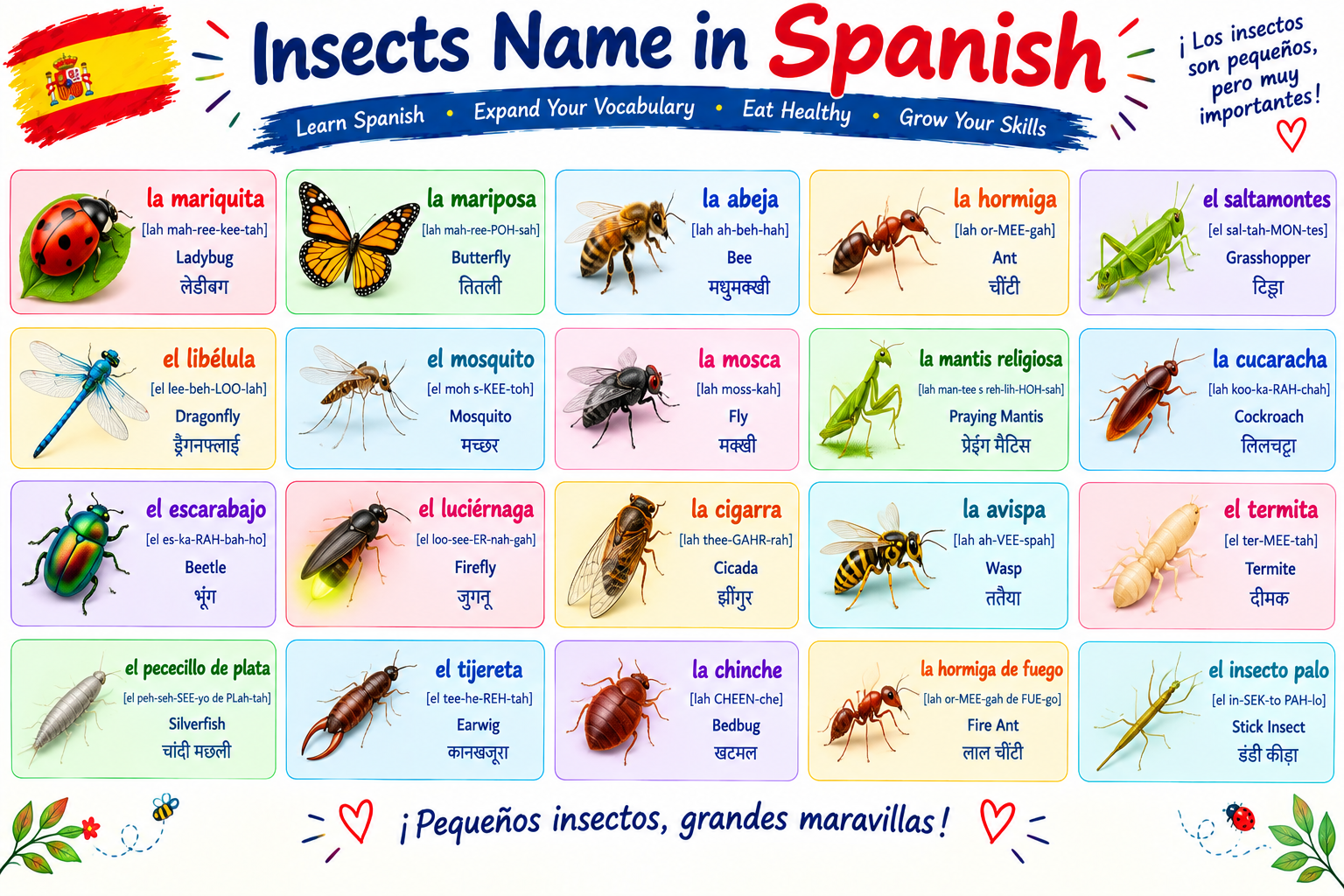
Insects Name in Spanish : Learning the 20 insects in Spanish language is a fun way to expand your Spanish vocabulary. Insects are all around us, so knowing their names can help beginners describe nature, animals, gardens, and everyday situations more confidently.
In this guide, you will learn 20 common insect names in Spanish with easy pronunciation, English translation, and Hindi meaning. We have also included simple example sentences and FAQs to make learning easier.
20 Insects Name in Spanish Language
No.
Spanish Name
Pronunciation
English
Hindi
1
la hormiga
lah or-MEE-gah
Ant
चींटी
2
la abeja
lah ah-BEH-hah
Bee
मधुमक्खी
3
la mariposa
lah mah-ree-POH-sah
Butterfly
तितली
4
la polilla
lah poh-LEE-yah
Moth
पतंगा
5
la mosca
lah MOHS-kah
Fly
मक्खी
6
el mosquito
el mohs-KEE-toh
Mosquito
मच्छर
7
el escarabajo
el ehs-kah-rah-BAH-hoh
Beetle
भृंग / बीटल
8
la mariquita
lah mah-ree-KEE-tah
Ladybug
लेडीबग
9
la libélula
lah lee-BEH-loo-lah
Dragonfly
व्याध पतंग / ड्रैगनफ्लाई
10
el saltamontes
el sal-tah-MON-tehs
Grasshopper
टिड्डा
11
el grillo
el GREE-yoh
Cricket
झींगुर
12
la cucaracha
lah koo-kah-RAH-chah
Cockroach
तिलचट्टा
13
la avispa
lah ah-BEES-pah
Wasp
ततैया
14
la termita
lah tehr-MEE-tah
Termite
दीमक
15
la pulga
lah POOL-gah
Flea
पिस्सू
16
el piojo
el PEE-oh-hoh
Louse
जूँ
17
la mantis religiosa
lah MAN-tees reh-lee-hee-OH-sah
Praying mantis
प्रेइंग मैन्टिस
18
la luciérnaga
lah loo-see-EHR-nah-gah
Firefly
जुगनू
19
la cigarra
lah see-GAH-rrah
Cicada
सिकाडा
20
la chinche
lah CHEEN-cheh
Bedbug / Bug
खटमल / कीड़ा
20 insects name in spanish Language
Pronunciation note: The pronunciation shown above is an easy English-style guide for beginners. Spanish pronunciation can vary slightly between regions.
1. La Hormiga – Ant
La hormiga means ant in Spanish. Ants are small social insects that usually live in colonies.
Example: La hormiga es muy pequeña.
The ant is very small.
2. La Abeja – Bee
La abeja means bee. Bees are important pollinators and are well known for producing honey.
Example: La abeja está sobre la flor.
The bee is on the flower.
3. La Mariposa – Butterfly
La mariposa means butterfly. This is one of the most useful nature-related Spanish vocabulary words for beginners.
Example: La mariposa tiene alas coloridas.
The butterfly has colorful wings.
4. La Polilla – Moth
La polilla means moth.
Example: La polilla vuela por la noche.
The moth flies at night.
5. La Mosca – Fly
La mosca means fly.
Example: La mosca está en la ventana.
The fly is on the window.
6. El Mosquito – Mosquito
El mosquito means mosquito.
Example: Hay un mosquito en la habitación.
There is a mosquito in the room.
7. El Escarabajo – Beetle
El escarabajo means beetle.
Example: El escarabajo camina sobre la hoja.
The beetle walks on the leaf.
8. La Mariquita – Ladybug
La mariquita means ladybug. In some Spanish-speaking regions, other terms such as catarina are also used.
Example: La mariquita está sobre una hoja.
The ladybug is on a leaf.
9. La Libélula – Dragonfly
La libélula means dragonfly.
Example: La libélula vuela cerca del agua.
The dragonfly flies near the water.
10. El Saltamontes – Grasshopper
El saltamontes means grasshopper. The word literally relates to an insect that “jumps over” or “jumps on” the grass.
Example: El saltamontes salta muy alto.
The grasshopper jumps very high.
11. El Grillo – Cricket
El grillo means cricket.
Example: El grillo canta por la noche.
The cricket chirps at night.
12. La Cucaracha – Cockroach
La cucaracha means cockroach.
Example: La cucaracha está debajo de la mesa.
The cockroach is under the table.
13. La Avispa – Wasp
La avispa means wasp.
Example: La avispa está cerca de la comida.
The wasp is near the food.
14. La Termita – Termite
La termita means termite.
Example: La termita puede dañar la madera.
The termite can damage wood.
15. La Pulga – Flea
La pulga means flea.
Example: La pulga es un insecto muy pequeño.
The flea is a very small insect.
16. El Piojo – Louse
El piojo means louse. The plural is los piojos.
Example: El piojo es un parásito pequeño.
The louse is a small parasite.
17. La Mantis Religiosa – Praying Mantis
La mantis religiosa means praying mantis.
Example: La mantis religiosa está sobre una planta.
The praying mantis is on a plant.
18. La Luciérnaga – Firefly
La luciérnaga means firefly or lightning bug.
Example: La luciérnaga brilla por la noche.
The firefly glows at night.
19. La Cigarra – Cicada
La cigarra means cicada.
Example: La cigarra hace mucho ruido en verano.
The cicada makes a lot of noise in summer.
20. La Chinche – Bedbug / Bug
La chinche can refer to a bedbug or certain other true bugs depending on context. For bedbug specifically, chinche de cama is commonly used.
Example: La chinche de cama es muy pequeña.
The bedbug is very small.
Useful Spanish Vocabulary About Insects
Besides individual insect names, learning a few related words can help you create sentences.
Spanish
English
Hindi
el insecto
insect
कीट
los insectos
insects
कीड़े / कीट
las alas
wings
पंख
las patas
legs
पैर
las antenas
antennae
स्पर्शक
la flor
flower
फूल
el jardín
garden
बगीचा
volar
to fly
उड़ना
saltar
to jump
कूदना
picar
to sting / bite
डंक मारना / काटना
Example
El insecto tiene seis patas.
The insect has six legs.
La mariposa vuela sobre la flor.
The butterfly flies over the flower.
La abeja está en el jardín.
The bee is in the garden.
Common Sentences About Insects in Spanish
Here are some simple sentences that beginners can practice:
Me gustan las mariposas. — I like butterflies.
No me gustan los mosquitos. — I don’t like mosquitoes.
La abeja está en la flor. — The bee is on the flower.
La hormiga es pequeña. — The ant is small.
El saltamontes salta. — The grasshopper jumps.
El grillo canta por la noche. — The cricket chirps at night.
La libélula vuela rápido. — The dragonfly flies fast.
La luciérnaga brilla de noche. — The firefly glows at night.
Hay una mariposa en el jardín. — There is a butterfly in the garden.
¿Qué insecto es? — What insect is it?
How to Ask About Insects in Spanish
You can use ¿Qué insecto es? when you want to ask, “What insect is it?”
Question:
¿Qué insecto es?
Answer:
Es una mariposa.
It is a butterfly.
You can also ask:
¿Te gustan las mariposas?
Do you like butterflies?
Sí, me gustan las mariposas.
Yes, I like butterflies.
Another useful question is:
¿Dónde está la abeja?
Where is the bee?
La abeja está en la flor.
The bee is on the flower.
Tips to Memorize Insect Names in Spanish
Learning vocabulary in small groups can make memorization easier. Start with five words, such as hormiga, abeja, mariposa, mosca and mosquito.
Next, learn words that are easy to associate with pictures, such as libélula, mariquita, saltamontes and luciérnaga.
You can also use flashcards. Put the Spanish word on one side and the picture or English meaning on the other side. Finally, create short sentences using each word.
For example:
La mariposa es bonita.
The butterfly is beautiful.
La hormiga camina.
The ant walks.
El mosquito vuela.
The mosquito flies.
This method helps you remember both the vocabulary and how to use it naturally.
Frequently Asked Questions
1. How do you say ant in Spanish?
Ant is hormiga in Spanish. The complete form is la hormiga.
2. How do you say bee in Spanish?
Bee is abeja in Spanish.
3. How do you say butterfly in Spanish?
Butterfly is mariposa in Spanish.
4. How do you say moth in Spanish?
Moth is polilla in Spanish.
5. How do you say fly in Spanish?
Fly is mosca in Spanish.
6. How do you say mosquito in Spanish?
Mosquito is mosquito in Spanish. The complete form is el mosquito.
7. How do you say beetle in Spanish?
Beetle is escarabajo in Spanish.
8. How do you say ladybug in Spanish?
Ladybug is mariquita in Spanish.
9. How do you say dragonfly in Spanish?
Dragonfly is libélula in Spanish.
10. How do you say grasshopper in Spanish?
Grasshopper is saltamontes in Spanish.
11. How do you say cricket in Spanish?
Cricket is grillo in Spanish.
12. How do you say cockroach in Spanish?
Cockroach is cucaracha in Spanish.
13. How do you say wasp in Spanish?
Wasp is avispa in Spanish.
14. How do you say termite in Spanish?
Termite is termita in Spanish.
15. How do you say flea in Spanish?
Flea is pulga in Spanish.
16. How do you say louse in Spanish?
Louse is piojo in Spanish.
17. How do you say praying mantis in Spanish?
Praying mantis is mantis religiosa in Spanish.
18. How do you say firefly in Spanish?
Firefly is luciérnaga in Spanish.
19. How do you say cicada in Spanish?
Cicada is cigarra in Spanish.
20. How do you say bedbug in Spanish?
Bedbug is chinche de cama in Spanish.
21. How many insect names are included in this article?
This article includes 20 common insect names in Spanish with pronunciation, English translations, and Hindi meanings.
22. What is insect called in Spanish?
Insect is insecto in Spanish.
23. How do you say insects in Spanish?
Insects is insectos in Spanish.
24. How do you say “I like butterflies” in Spanish?
You can say “Me gustan las mariposas.”
25. How can I memorize insect names in Spanish?
Practice five insect names at a time, use pictures or flashcards, and create short Spanish sentences with each word.
Conclusion
Learning 20 insects in Spanish language can help beginners develop useful vocabulary related to nature and everyday life. Words such as la hormiga, la abeja, la mariposa, el mosquito, la libélula, el saltamontes and la luciérnaga are easy to practice with pictures and simple sentences.
For better results, review a few words every day and use them in short Spanish sentences. With regular practice, these insect names can become a natural part of your Spanish vocabulary.