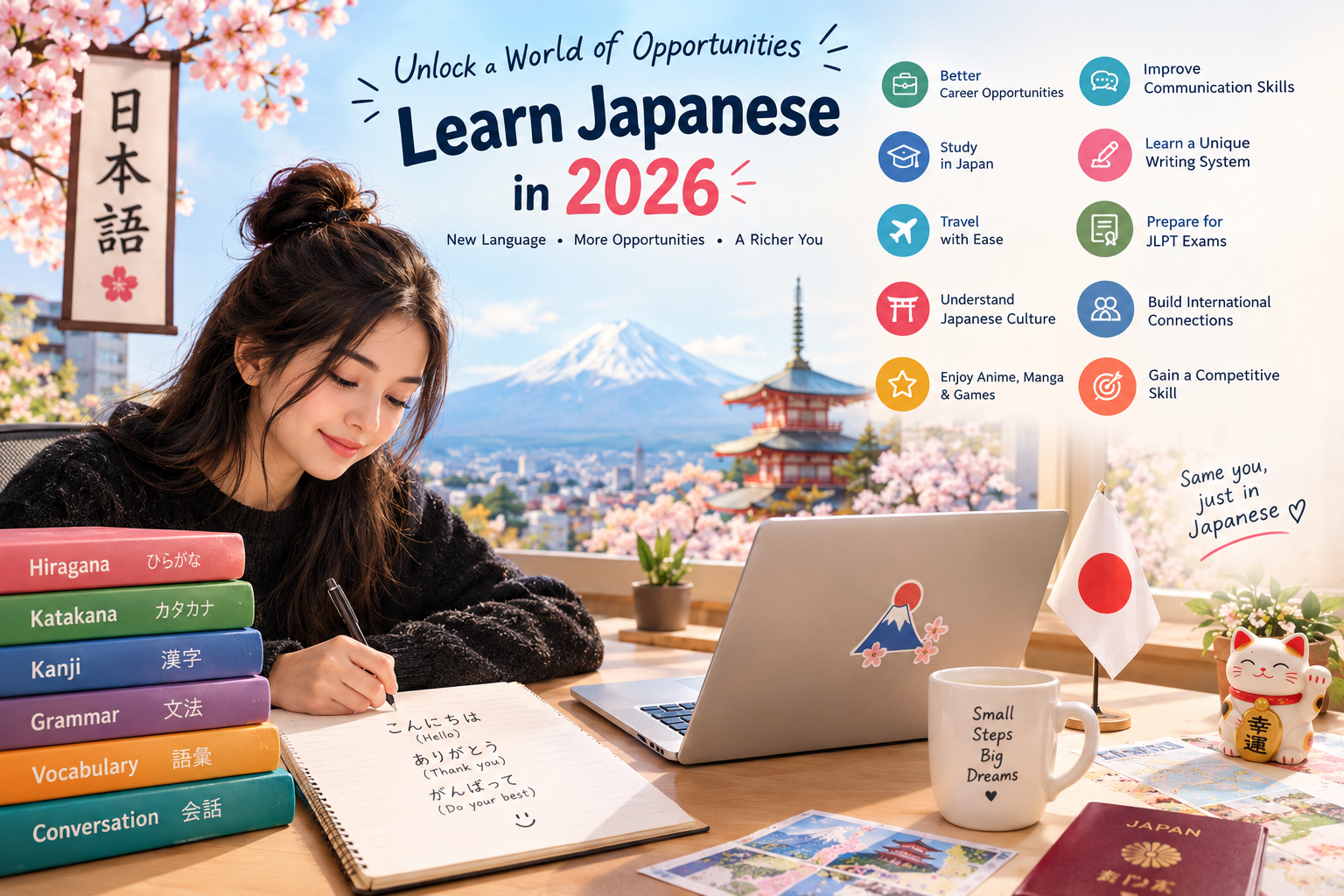
Benefits of Learning Japanese Course in 2026
Learning a new language can open doors to education, career opportunities, travel, and cultural experiences. In 2026, learning Japanese is becoming an increasingly useful skill for students, professionals, travelers, and language enthusiasts. Japan has a strong presence in technology, automobiles, manufacturing, entertainment, tourism, and international business, making Japanese a valuable addition to your skill set.
A structured Japanese language course can help learners build practical communication skills while developing an understanding of Japanese culture and everyday life.
Why Learn Japanese in 2026?
Japan continues to attract people from around the world for education, employment, business, tourism, and cultural experiences. Japan’s inbound tourism sector remains particularly active. According to the Japan National Tourism Organization (JNTO), Japan recorded more than 42.6 million international visitors in 2025, a record annual total.
JNTO data also shows that international visitor numbers remained substantial during 2026, with 3.44 million visitors in July 2026 alone.
This growing international connection makes Japanese language skills useful in several areas.
1. Improve Career Opportunities
Japanese can be a valuable additional skill for people interested in working with Japanese companies or organizations.
Japan has major industries in areas such as:
- Automotive
- Electronics
- Technology
- Manufacturing
- Robotics
- Gaming
- Animation
- Tourism
- Finance
- International trade
Being able to communicate in Japanese can help professionals interact more effectively with Japanese-speaking colleagues, customers, and business partners.
For students, starting a Japanese course early can also provide time to develop language proficiency before entering higher education or the workplace.
2. Study in Japan
Japan offers opportunities for international students across fields such as engineering, technology, business, science, design, and the humanities.
Although some programs are available in English, knowing Japanese can make everyday communication easier and can help students participate more comfortably in life outside the classroom.
Learning Japanese before studying in Japan can help students become familiar with:
- Hiragana
- Katakana
- Basic Kanji
- Japanese grammar
- Everyday vocabulary
- Conversation
- Japanese etiquette
A Japanese course can therefore provide useful preparation for students considering education in Japan.
3. Make Traveling in Japan Easier
Japan is one of the world’s major tourism destinations. In 2025, international arrivals exceeded 42 million, according to JNTO.
Learning basic Japanese can make travel more comfortable because visitors can understand common signs, greetings, menus, transportation information, and everyday conversations.
Even simple phrases can help travelers communicate when:
- Ordering food
- Asking for directions
- Shopping
- Using public transportation
- Checking into accommodation
- Visiting local attractions
Knowing the language can also make it easier to explore places beyond the most tourist-oriented areas.
4. Understand Japanese Culture More Deeply
Language and culture are closely connected. Studying Japanese gives learners an opportunity to understand aspects of Japanese society that may not be obvious through translations alone.
A Japanese course can introduce learners to topics such as:
- Japanese customs
- Social etiquette
- Traditional festivals
- Food culture
- History
- Literature
- Popular culture
- Everyday communication styles
Understanding the language can provide additional context when experiencing Japanese films, music, books, games, and other cultural content.
5. Explore Japanese Anime, Manga, and Games
Japanese popular culture has a huge international audience. Anime, manga, games, music, and other forms of Japanese entertainment attract fans around the world.
Learning Japanese allows learners to engage with Japanese-language content more directly and understand expressions that may be difficult to capture fully in translation.
For students who already enjoy Japanese entertainment, this can make language learning more interesting and motivating.
6. Develop Communication Skills
Learning another language requires regular practice in listening, speaking, reading, and writing.
A Japanese course can help learners gradually develop these four skills through structured lessons and exercises.
Students can practice:
- Listening to Japanese conversations
- Speaking common phrases
- Reading Japanese scripts
- Writing basic Japanese
- Building vocabulary
- Understanding sentence structures
These skills can also encourage learners to become more confident when communicating with people from different linguistic backgrounds.
7. Learn a Unique Writing System
One interesting aspect of Japanese is its writing system. Japanese commonly uses Hiragana, Katakana, and Kanji.
Learning these writing systems provides students with a different linguistic experience from languages that use the Latin alphabet.
A structured course can introduce these scripts gradually, helping beginners understand how they are used in everyday Japanese.
8. Prepare for Japanese Language Proficiency Exams
Learners who want to demonstrate their Japanese ability can work toward recognized proficiency examinations such as the Japanese-Language Proficiency Test (JLPT).
A structured course can help students build their vocabulary, grammar, reading, and listening skills according to their target level.
Having a clear proficiency goal can also make language learning more organized and measurable.
9. Build International Connections
Japanese language skills can help learners communicate with Japanese-speaking people and connect with communities interested in Japan.
Whether through education, travel, professional activities, or cultural exchange, knowing Japanese can create opportunities to interact with people who share similar interests.
Language learning can therefore become more than an academic activity—it can become a way to build international connections.
10. Gain a Competitive Skill
Students and professionals often learn additional skills to differentiate themselves academically or professionally.
Japanese can complement other skills such as:
- Digital marketing
- Business
- Technology
- Design
- Tourism
- Translation
- International relations
- Engineering
Combining Japanese with another professional skill can create a broader skill profile.
For example, someone interested in digital marketing could develop Japanese communication skills alongside SEO, content marketing, or social media knowledge.
11. Understand Business Communication
Japan has a significant role in international business, and understanding Japanese can be useful when working with Japanese organizations.
A Japanese language course may also introduce learners to aspects of Japanese business communication, including formal expressions, greetings, and professional etiquette.
For anyone planning to work with Japanese clients or companies, cultural understanding can be an important part of effective communication.
12. Develop a Long-Term Learning Skill
Language learning is a long-term process that requires consistency. Studying Japanese can encourage learners to develop habits such as regular practice, memorization, listening, reading, and active communication.
Instead of trying to learn everything at once, students can progress step by step:
Hiragana → Katakana → Basic Grammar → Vocabulary → Conversation → Kanji → Intermediate Japanese
This gradual approach can make Japanese more manageable for beginners.
Who Should Learn Japanese in 2026?
A Japanese course can be useful for:
- Students interested in studying abroad
- Professionals working with Japanese companies
- Travelers planning to visit Japan
- Anime and manga enthusiasts
- Gaming enthusiasts
- Technology and engineering students
- Tourism professionals
- Business owners
- Language enthusiasts
- Anyone interested in Japanese culture
How to Start Learning Japanese
Beginners should start with the fundamentals rather than attempting advanced grammar immediately.
A good learning path can include:
- Learn Hiragana.
- Learn Katakana.
- Build basic vocabulary.
- Understand beginner grammar.
- Practice everyday conversations.
- Start learning common Kanji.
- Improve listening comprehension.
- Read simple Japanese sentences.
- Practice speaking regularly.
- Progress toward a suitable proficiency level.
A structured Japanese language course can make this process easier by providing lessons, practice activities, feedback, and a logical learning sequence.
Conclusion
Learning Japanese in 2026 can provide benefits across education, careers, travel, cultural understanding, and personal development. Japan’s continued importance in international tourism and its presence across technology, manufacturing, entertainment, and business make Japanese a useful language for learners with different goals.
Whether you want to study in Japan, travel more confidently, understand Japanese culture, communicate with Japanese speakers, or add a new skill to your professional profile, a Japanese language course can be a practical place to start.
The key is consistency. Learning Japanese takes time, but progressing from basic scripts and vocabulary to real conversations can be a rewarding experience.
I kept the article professional + SEO-friendly, with natural keyword placement for phrases like “Japanese language course,” “learn Japanese,” and “learning Japanese in 2026” without stuffing them everywhere like an SEO robot having a crisis 😭.