Learning wild animals name in Spanish is a useful way to build everyday vocabulary. Whether you are a beginner, student, traveler, or parent teaching Spanish, these animal names can help you understand conversations, stories, documentaries, and Spanish learning materials more easily.
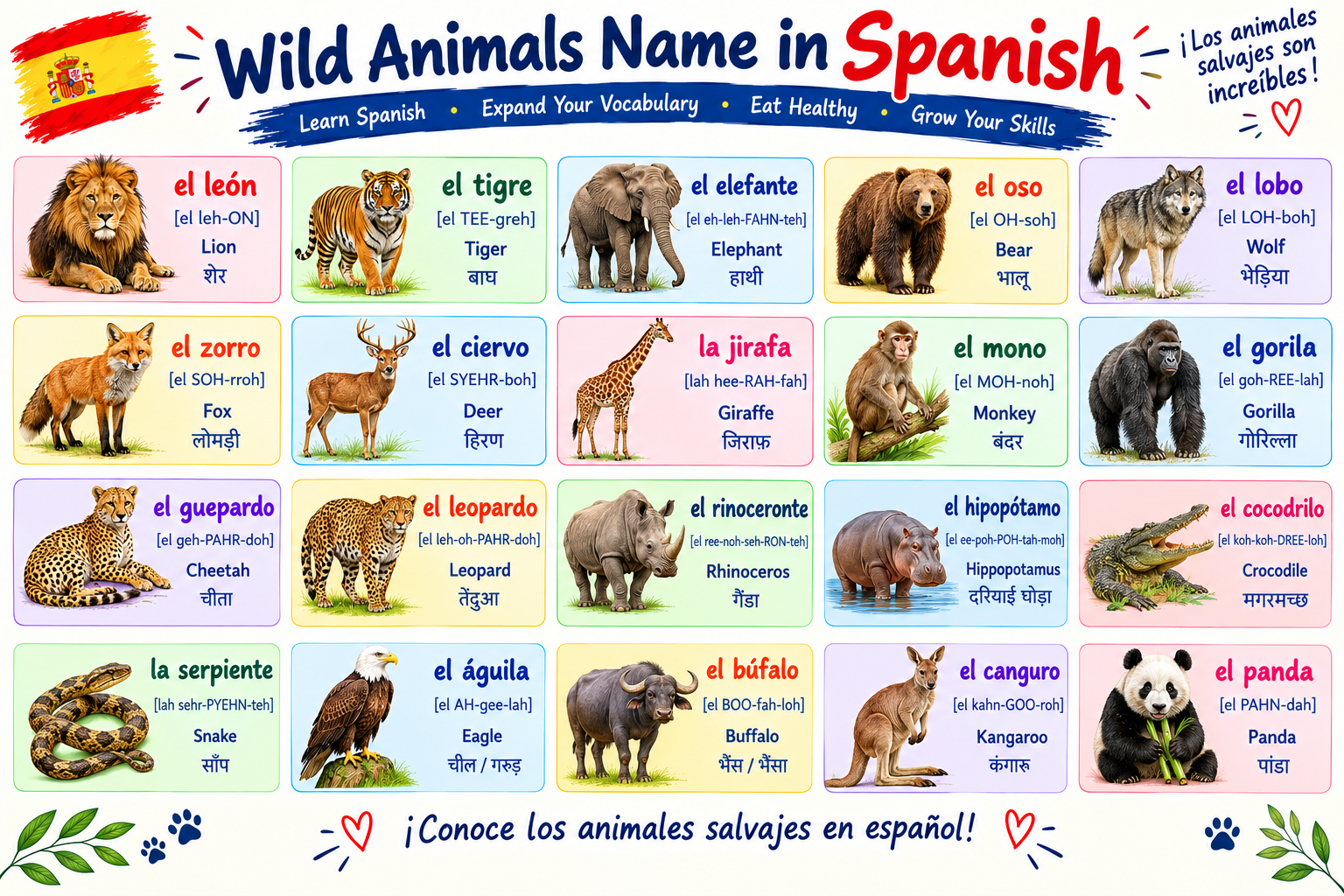
Below is a list of 20 wild animals in Spanish with easy English-style pronunciation, English meaning, and Hindi translation.
20 Wild Animals Name in Spanish
No.
Spanish Name
Pronunciation
English
Hindi
1
el león
el leh-ON
Lion
शेर
2
el tigre
el TEE-greh
Tiger
बाघ
3
el elefante
el eh-leh-FAHN-teh
Elephant
हाथी
4
el oso
el OH-soh
Bear
भालू
5
el lobo
el LOH-boh
Wolf
भेड़िया
6
el zorro
el SOH-rroh
Fox
लोमड़ी
7
el ciervo
el SYEHR-boh
Deer
हिरण
8
la jirafa
lah hee-RAH-fah
Giraffe
जिराफ़
9
el mono
el MOH-noh
Monkey
बंदर
10
el gorila
el goh-REE-lah
Gorilla
गोरिल्ला
11
el guepardo
el geh-PAHR-doh
Cheetah
चीता
12
el leopardo
el leh-oh-PAHR-doh
Leopard
तेंदुआ
13
el rinoceronte
el ree-noh-seh-RON-teh
Rhinoceros
गैंडा
14
el hipopótamo
el ee-poh-POH-tah-moh
Hippopotamus
दरियाई घोड़ा
15
el cocodrilo
el koh-koh-DREE-loh
Crocodile
मगरमच्छ
16
la serpiente
lah sehr-PYEHN-teh
Snake
साँप
17
el águila
el AH-gee-lah
Eagle
गरुड़ / चील
18
el búfalo
el BOO-fah-loh
Buffalo
भैंस / जंगली भैंसा
19
el canguro
el kahn-GOO-roh
Kangaroo
कंगारू
20
el panda
el PAHN-dah
Panda
पांडा
20 Wild animals in spanish
Pronunciation note: The pronunciation column uses an easy English-style guide for beginners. It is not a replacement for standard Spanish phonetic notation.
1. El León – Lion
El león means lion in Spanish. Lions are commonly associated with strength and courage.
Example: El león es muy fuerte.
The lion is very strong.
2. El Tigre – Tiger
El tigre means tiger. It is one of the most recognizable wild animals.
Example: El tigre vive en la selva.
The tiger lives in the jungle.
3. El Elefante – Elephant
El elefante means elephant. It is one of the largest land animals.
Example: El elefante es enorme.
The elephant is enormous.
4. El Oso – Bear
El oso means bear.
Example: El oso busca comida.
The bear looks for food.
5. El Lobo – Wolf
El lobo means wolf.
Example: El lobo vive en el bosque.
The wolf lives in the forest.
6. El Zorro – Fox
El zorro means fox.
Example: El zorro es un animal salvaje.
The fox is a wild animal.
7. El Ciervo – Deer
El ciervo means deer.
Example: El ciervo corre rápidamente.
The deer runs quickly.
8. La Jirafa – Giraffe
La jirafa means giraffe. Notice that this animal uses the feminine article la.
Example: La jirafa tiene un cuello largo.
The giraffe has a long neck.
9. El Mono – Monkey
El mono means monkey.
Example: El mono está en el árbol.
The monkey is in the tree.
10. El Gorila – Gorilla
El gorila means gorilla.
Example: El gorila es muy grande.
The gorilla is very large.
11. El Guepardo – Cheetah
El guepardo means cheetah.
Example: El guepardo corre muy rápido.
The cheetah runs very fast.
12. El Leopardo – Leopard
El leopardo means leopard.
Example: El leopardo caza por la noche.
The leopard hunts at night.
13. El Rinoceronte – Rhinoceros
El rinoceronte means rhinoceros.
Example: El rinoceronte tiene un cuerno.
The rhinoceros has a horn.
14. El Hipopótamo – Hippopotamus
El hipopótamo means hippopotamus.
Example: El hipopótamo vive cerca del agua.
The hippopotamus lives near water.
15. El Cocodrilo – Crocodile
El cocodrilo means crocodile.
Example: El cocodrilo está en el río.
The crocodile is in the river.
16. La Serpiente – Snake
La serpiente means snake.
Example: La serpiente se mueve lentamente.
The snake moves slowly.
17. El Águila – Eagle
El águila means eagle. Although águila is a feminine noun, it normally uses el in the singular because of its stressed initial a sound.
Example: El águila vuela muy alto.
The eagle flies very high.
18. El Búfalo – Buffalo
El búfalo means buffalo.
Example: El búfalo vive en grupos.
The buffalo lives in groups.
19. El Canguro – Kangaroo
El canguro means kangaroo.
Example: El canguro puede saltar muy alto.
The kangaroo can jump very high.
20. El Panda – Panda
El panda means panda.
Example: El panda come bambú.
The panda eats bamboo.
Useful Spanish Sentences About Wild Animals
Here are some simple sentences that beginners can practice:
Me gustan los animales salvajes. — I like wild animals.
El león es fuerte. — The lion is strong.
El tigre es rápido. — The tiger is fast.
El elefante es grande. — The elephant is big.
El mono está en el árbol. — The monkey is in the tree.
La jirafa tiene un cuello largo. — The giraffe has a long neck.
El oso vive en el bosque. — The bear lives in the forest.
El águila vuela alto. — The eagle flies high.
El cocodrilo vive en el agua. — The crocodile lives in water.
El panda come bambú. — The panda eats bamboo.
How to Ask About Wild Animals in Spanish
You can use these simple questions when practicing Spanish:
¿Qué animal es?
What animal is it?
Es un león.
It is a lion.
¿Dónde vive el tigre?
Where does the tiger live?
El tigre vive en la selva.
The tiger lives in the jungle.
¿Cuál es tu animal favorito?
What is your favorite animal?
Mi animal favorito es el elefante.
My favorite animal is the elephant.
Tips to Learn Wild Animal Names in Spanish
Learning vocabulary becomes easier when you connect each Spanish word with an image. Start with five animals and practice them every day. Then add five more.
You can also make simple sentences such as “El león es fuerte” or “El panda come bambú.” This helps you remember both the animal name and its correct usage.
Flashcards are another useful method. Write the Spanish word on one side and the English or Hindi meaning on the other side.
Frequently Asked Questions
1. How do you say lion in Spanish?
Lion is león in Spanish. The complete form is el león.
2. How do you say tiger in Spanish?
Tiger is tigre in Spanish. The complete form is el tigre.
3. How do you say elephant in Spanish?
Elephant is elefante in Spanish.
4. How do you say bear in Spanish?
Bear is oso in Spanish.
5. How do you say wolf in Spanish?
Wolf is lobo in Spanish.
6. How do you say fox in Spanish?
Fox is zorro in Spanish.
7. How do you say deer in Spanish?
Deer is ciervo in Spanish.
8. How do you say giraffe in Spanish?
Giraffe is jirafa in Spanish.
9. How do you say monkey in Spanish?
Monkey is mono in Spanish.
10. How do you say gorilla in Spanish?
Gorilla is gorila in Spanish.
11. How do you say cheetah in Spanish?
Cheetah is guepardo in Spanish.
12. How do you say leopard in Spanish?
Leopard is leopardo in Spanish.
13. How do you say rhinoceros in Spanish?
Rhinoceros is rinoceronte in Spanish.
14. How do you say hippopotamus in Spanish?
Hippopotamus is hipopótamo in Spanish.
15. How do you say crocodile in Spanish?
Crocodile is cocodrilo in Spanish.
16. How do you say snake in Spanish?
Snake is serpiente in Spanish.
17. How do you say eagle in Spanish?
Eagle is águila in Spanish.
18. How do you say buffalo in Spanish?
Buffalo is búfalo in Spanish.
19. How do you say kangaroo in Spanish?
Kangaroo is canguro in Spanish.
20. How do you say panda in Spanish?
Panda is panda in Spanish.
21. How many wild animals are included in this article?
This article includes 20 wild animal names in Spanish with pronunciation, English translations, and Hindi meanings.
22. What is wild animal called in Spanish?
A wild animal is called animal salvaje in Spanish.
23. How do you say wild animals in Spanish?
Wild animals is animales salvajes in Spanish.
24. How do you say “I like wild animals” in Spanish?
You can say “Me gustan los animales salvajes.”
25. How can I memorize wild animal names in Spanish?
Practice a few animal names every day, use flashcards and pictures, and create simple Spanish sentences using each animal name.
Conclusion
Learning 20 wild animals name in Spanish is a practical way to expand your Spanish vocabulary. Words such as león, tigre, elefante, oso, lobo, jirafa, guepardo, cocodrilo and panda are useful for beginners and students.
Practice these words regularly and use them in short sentences. With consistent practice, you can gradually build a stronger Spanish vocabulary.
1 Comment
Domestic Animals in Spanish - with Pronunciation, English & Hindi
September 27, 2026[…] Prevoius Article : Wild Animals Name In Spanish Language […]