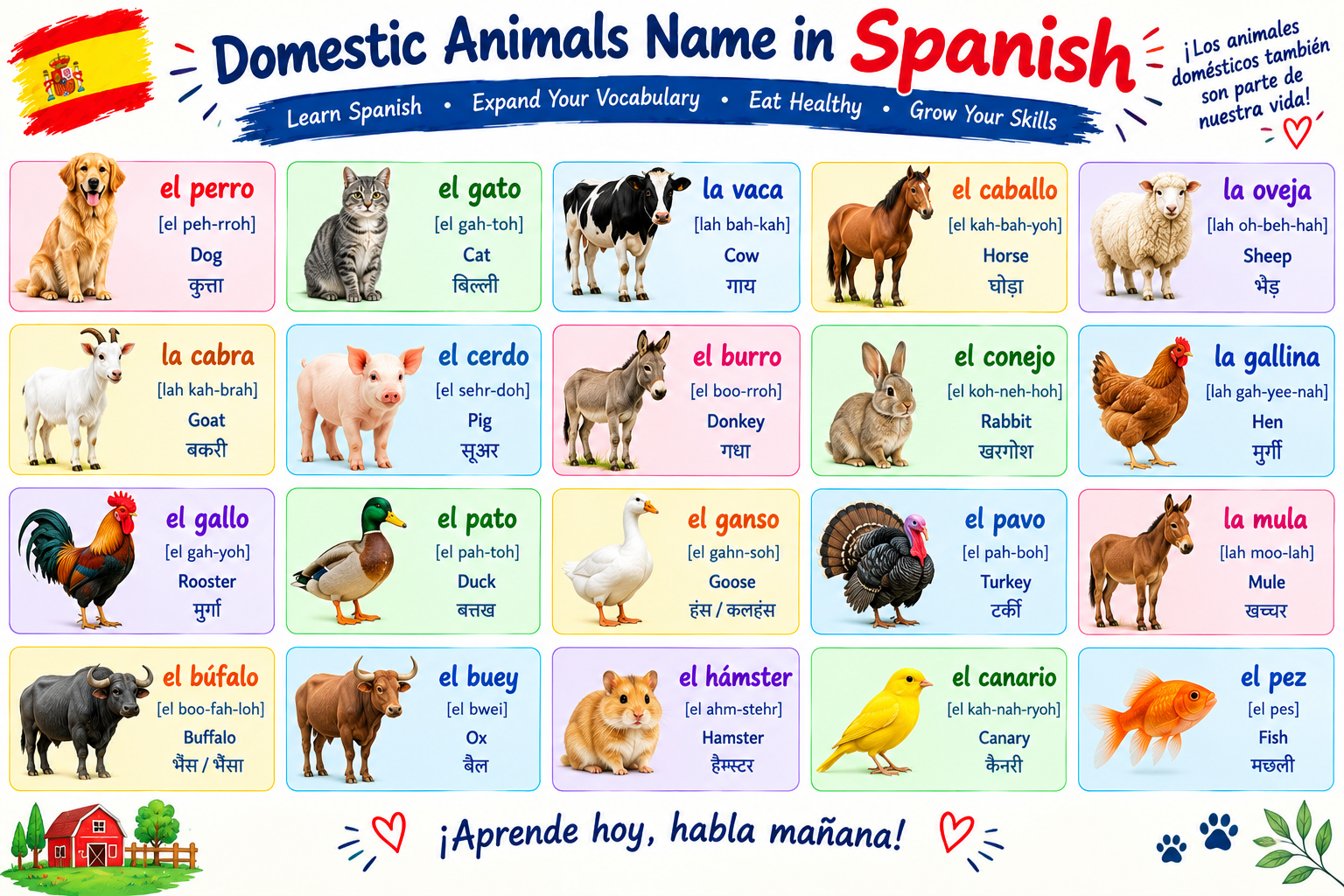
Domestic Animals in Spanish : Learning domestic animals name in Spanish is a great way to expand your everyday Spanish vocabulary. Domestic animals are commonly found on farms, in homes and around people. For beginners, learning these names with pronunciation and translations makes Spanish vocabulary easier to remember.
Below is a useful list of 20 domestic animal names in Spanish, along with easy pronunciation, English translation, and Hindi meaning.
20 Domestic Animals Name in Spanish
No.
Spanish Name
Pronunciation
English
Hindi
1
el perro
el PEH-rroh
Dog
कुत्ता
2
el gato
el GAH-toh
Cat
बिल्ली
3
la vaca
lah BAH-kah
Cow
गाय
4
el caballo
el kah-BAH-yoh
Horse
घोड़ा
5
la oveja
lah oh-BEH-hah
Sheep
भेड़
6
la cabra
lah KAH-brah
Goat
बकरी
7
el cerdo
el SEHR-doh
Pig
सूअर
8
el burro
el BOO-rroh
Donkey
गधा
9
el conejo
el koh-NEH-hoh
Rabbit
खरगोश
10
la gallina
lah gah-YEE-nah
Hen
मुर्गी
11
el gallo
el GAH-yoh
Rooster
मुर्गा
12
el pato
el PAH-toh
Duck
बत्तख
13
el pavo
el PAH-boh
Turkey
टर्की
14
la mula
lah MOO-lah
Mule
खच्चर
15
el búfalo
el BOO-fah-loh
Buffalo
भैंस / भैंसा
16
el buey
el BWEY
Ox
बैल
17
el hámster
el AHM-stehr
Hamster
हैम्स्टर
18
el canario
el kah-NAH-ryoh
Canary
कैनरी
19
el pez
el PES
Fish
मछली
20
la paloma
lah pah-LOH-mah
Pigeon / Dove
कबूतर
20 Domestic Animals in Spanish
Pronunciation note: The pronunciation column uses a simple English-style pronunciation guide for beginners. It is designed to make the Spanish words easier to read aloud.
1. El Perro – Dog
El perro means dog in Spanish. Dogs are common domestic animals and are often kept as pets.
Example: El perro juega en el jardín.
The dog plays in the garden.
2. El Gato – Cat
El gato means cat in Spanish.
Example: El gato duerme en la casa.
The cat sleeps in the house.
3. La Vaca – Cow
La vaca means cow. Cows are commonly raised on farms.
Example: La vaca come hierba.
The cow eats grass.
4. El Caballo – Horse
El caballo means horse.
Example: El caballo corre rápidamente.
The horse runs quickly.
5. La Oveja – Sheep
La oveja means sheep.
Example: La oveja está en el campo.
The sheep is in the field.
6. La Cabra – Goat
La cabra means goat.
Example: La cabra come hojas.
The goat eats leaves.
7. El Cerdo – Pig
El cerdo means pig.
Example: El cerdo vive en la granja.
The pig lives on the farm.
8. El Burro – Donkey
El burro means donkey.
Example: El burro lleva una carga.
The donkey carries a load.
9. El Conejo – Rabbit
El conejo means rabbit.
Example: El conejo come una zanahoria.
The rabbit eats a carrot.
10. La Gallina – Hen
La gallina means hen, the female chicken.
Example: La gallina pone huevos.
The hen lays eggs.
11. El Gallo – Rooster
El gallo means rooster.
Example: El gallo canta por la mañana.
The rooster crows in the morning.
12. El Pato – Duck
El pato means duck.
Example: El pato nada en el agua.
The duck swims in the water.
13. El Pavo – Turkey
El pavo means turkey.
Example: El pavo está en la granja.
The turkey is on the farm.
14. La Mula – Mule
La mula means mule.
Example: La mula camina por el campo.
The mule walks through the countryside.
15. El Búfalo – Buffalo
El búfalo means buffalo.
Example: El búfalo vive en la granja.
The buffalo lives on the farm.
16. El Buey – Ox
El buey means ox. An ox is a domesticated bovine traditionally used for farm work.
Example: El buey trabaja en el campo.
The ox works in the field.
17. El Hámster – Hamster
El hámster means hamster. Hamsters are commonly kept as small pets.
Example: El hámster corre en su rueda.
The hamster runs on its wheel.
18. El Canario – Canary
El canario means canary, a small bird often kept as a pet.
Example: El canario canta muy bien.
The canary sings very well.
19. El Pez – Fish
El pez means fish when referring to a living fish.
Example: El pez nada en el acuario.
The fish swims in the aquarium.
Useful note:pez is used for a living fish, while pescado generally refers to fish as food.
20. La Paloma – Pigeon / Dove
La paloma means pigeon or dove, depending on context.
Example: La paloma vuela sobre la casa.
The pigeon flies over the house.
Common Spanish Sentences About Domestic Animals
Here are some easy sentences for Spanish beginners:
Tengo un perro. — I have a dog.
Tengo un gato. — I have a cat.
La vaca come hierba. — The cow eats grass.
El caballo corre rápido. — The horse runs fast.
La oveja está en el campo. — The sheep is in the field.
La cabra come hojas. — The goat eats leaves.
El conejo es pequeño. — The rabbit is small.
El pato nada en el agua. — The duck swims in the water.
El gallo canta por la mañana. — The rooster crows in the morning.
El perro es mi mascota. — The dog is my pet.
Domestic Animals Vocabulary in Spanish
The Spanish word for domestic animal is animal doméstico. The plural form is animales domésticos.
You may also hear mascota, which means pet. For example:
Mi perro es mi mascota.
My dog is my pet.
However, not every domestic animal is necessarily a pet. A cow, horse, or sheep can be a domestic animal without being a household pet.
How to Learn Domestic Animal Names in Spanish
Start by learning five words at a time. For example, begin with perro, gato, vaca, caballo and oveja. Once you remember them, move to the next five.
Pictures and flashcards can also make vocabulary practice easier. Try saying the Spanish word whenever you see an animal. You can also create short sentences to practice both vocabulary and grammar.
For example:
El gato es pequeño.
The cat is small.
La vaca es grande.
The cow is big.
This method helps you learn words in context instead of memorizing isolated vocabulary.
Frequently Asked Questions About Spanish
1. How do you say dog in Spanish?
Dog is perro in Spanish. The complete form is el perro.
2. How do you say cat in Spanish?
Cat is gato in Spanish. The complete form is el gato.
3. How do you say cow in Spanish?
Cow is vaca in Spanish.
4. How do you say horse in Spanish?
Horse is caballo in Spanish.
5. How do you say sheep in Spanish?
Sheep is oveja in Spanish.
6. How do you say goat in Spanish?
Goat is cabra in Spanish.
7. How do you say pig in Spanish?
Pig is cerdo in Spanish.
8. How do you say donkey in Spanish?
Donkey is burro in Spanish.
9. How do you say rabbit in Spanish?
Rabbit is conejo in Spanish.
10. How do you say hen in Spanish?
Hen is gallina in Spanish.
11. How do you say rooster in Spanish?
Rooster is gallo in Spanish.
12. How do you say duck in Spanish?
Duck is pato in Spanish.
13. How do you say turkey in Spanish?
Turkey is pavo in Spanish.
14. How do you say mule in Spanish?
Mule is mula in Spanish.
15. How do you say buffalo in Spanish?
Buffalo is búfalo in Spanish.
16. How do you say ox in Spanish?
Ox is buey in Spanish.
17. How do you say hamster in Spanish?
Hamster is hámster in Spanish.
18. How do you say canary in Spanish?
Canary is canario in Spanish.
19. How do you say fish in Spanish?
Fish is pez in Spanish when referring to a living fish.
20. How do you say pigeon in Spanish?
Pigeon is paloma in Spanish.
21. How many domestic animals are included in this article?
This article includes 20 domestic animal names in Spanish with pronunciation, English translations, and Hindi meanings.
22. What is domestic animal called in Spanish?
Domestic animal is animal doméstico in Spanish.
23. How do you say domestic animals in Spanish?
Domestic animals is animales domésticos in Spanish.
24. How do you say “I have a dog” in Spanish?
You can say “Tengo un perro.”
25. How can I memorize domestic animal names in Spanish?
Practice five animal names at a time, use pictures or flashcards, and make short Spanish sentences with each word.
Conclusion
Learning 20 domestic animals name in Spanish is an excellent way to develop basic Spanish vocabulary. Words such as perro, gato, vaca, caballo, oveja, cabra, conejo and pato are useful for everyday conversations and beginner-level Spanish learning.
Practice these animal names regularly and use them in simple sentences. This will help you remember the vocabulary and become more comfortable using Spanish.

1 Comment
20 Birds Name in Spanish with Pronunciation, English & Hindi
September 28, 2026[…] Prevoius Article : Domestic Animals Name In Spanish Language […]