Past Perfect Continuous Negative Tense in English
Rules, Structure, Examples, and Uses
1. Introduction
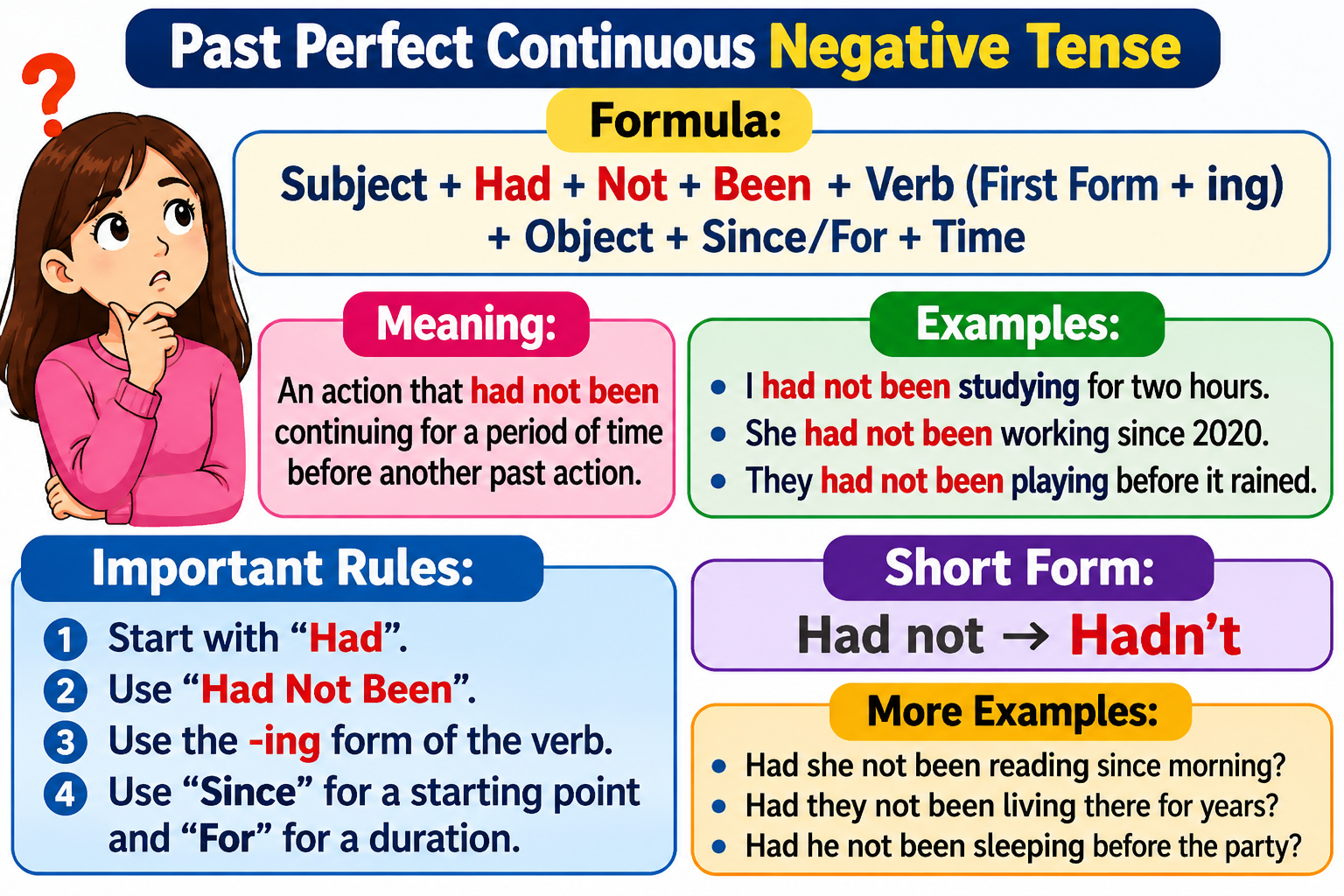
The Past Perfect Continuous Negative Tense is used to describe an action that had not been continuing for a period of time before another action or a specific point in the past.
It tells us that an activity was not happening or continuing during a particular period before something else happened in the past.
For example:
- I had not been studying for two hours. (मैं दो घंटे से पढ़ाई नहीं कर रहा था।)
- She had not been working there since 2020. (वह 2020 से वहाँ काम नहीं कर रही थी।)
- They had not been playing cricket before it started raining. (बारिश शुरू होने से पहले वे क्रिकेट नहीं खेल रहे थे।)
2. Definition of Past Perfect Continuous Negative Tense
The Past Perfect Continuous Negative Tense describes an action that had not been continuing over a period of time before another past action or a particular moment in the past.
It is used to express the absence or non-continuation of an activity in the past.
3. Structure of Past Perfect Continuous Negative Tense
The basic structure is:
Subject + Had + Not + Been + Verb (First Form + ing) + Object + Since/For + Time
Formula
| Subject | Helping Verb | Negative | Main Verb | Example |
|---|---|---|---|---|
| I | had | not been | working | I had not been working. |
| We | had | not been | studying | We had not been studying. |
| You | had | not been | waiting | You had not been waiting. |
| He | had | not been | playing | He had not been playing. |
| She | had | not been | cooking | She had not been cooking. |
| They | had | not been | travelling | They had not been travelling. |
Important: We use had not been with all subjects, including I, We, You, He, She, It, and They.
The short form of had not is hadn’t.
Examples:
- I hadn’t been sleeping.
- She hadn’t been working.
- They hadn’t been studying.
4. Important Rules
Rule 1: Use “Had Not Been” with Every Subject
In Past Perfect Continuous Negative Tense, the helping verb structure remains the same for all subjects.
Examples:
- He had not been sleeping. (वह सो नहीं रहा था।)
- They had not been working. (वे काम नहीं कर रहे थे।)
- I had not been learning English. (मैं अंग्रेज़ी नहीं सीख रहा था।)
Rule 2: Use the First Form of the Verb with “ing”
The main verb must always be in its -ing form.
Examples:
- Play → Playing
- Read → Reading
- Work → Working
- Write → Writing
- Run → Running
- Study → Studying
Sentences:
- She had not been reading. (वह पढ़ नहीं रही थी।)
- They had not been playing. (वे खेल नहीं रहे थे।)
Rule 3: Use “Since” for a Starting Point
Use since when mentioning the specific time at which an action started.
Examples:
- Since morning
- Since Monday
- Since 2020
- Since 5 o’clock
- Since childhood
Sentences:
- He had not been working since morning. (वह सुबह से काम नहीं कर रहा था।)
- She had not been studying since Monday. (वह सोमवार से पढ़ाई नहीं कर रही थी।)
Rule 4: Use “For” for a Period of Time
Use for when mentioning the duration of an action.
Examples:
- For two hours
- For three days
- For five years
- For a long time
- For ten minutes
Sentences:
- I had not been sleeping for two hours. (मैं दो घंटे से सो नहीं रहा था।)
- They had not been living there for five years. (वे वहाँ पाँच साल से नहीं रह रहे थे।)
5. Uses of Past Perfect Continuous Negative Tense
Use 1: To Describe an Activity That Was Not Continuing Before Another Past Action
- I had not been studying before my friend arrived. (मेरे दोस्त के आने से पहले मैं पढ़ाई नहीं कर रहा था।)
- She had not been cooking before the guests arrived. (मेहमानों के आने से पहले वह खाना नहीं बना रही थी।)
Use 2: To Express That an Activity Had Not Been Happening for a Certain Duration
- He had not been working for two days. (वह दो दिनों से काम नहीं कर रहा था।)
- We had not been practising for a week. (हम एक सप्ताह से अभ्यास नहीं कर रहे थे।)
Use 3: To Explain the Absence of an Ongoing Activity in the Past
- He was not tired because he had not been running. (वह थका हुआ नहीं था क्योंकि वह दौड़ नहीं रहा था।)
- She was not exhausted because she had not been working. (वह थकी हुई नहीं थी क्योंकि वह काम नहीं कर रही थी।)
Use 4: To Describe an Activity That Had Not Continued Up to a Specific Time in the Past
- By 8 PM, I had not been working for several hours. (रात 8 बजे तक मैं कई घंटों से काम नहीं कर रहा था।)
- By last year, he had not been teaching for a long time. (पिछले साल तक वह लंबे समय से पढ़ा नहीं रहा था।)
6. Daily-Life Examples with Hindi Meanings
| English Sentence | Hindi Meaning |
|---|---|
| I had not been learning English for six months. | मैं छह महीने से अंग्रेज़ी नहीं सीख रहा था। |
| She had not been cooking since morning. | वह सुबह से खाना नहीं बना रही थी। |
| He had not been playing football for two hours. | वह दो घंटे से फुटबॉल नहीं खेल रहा था। |
| They had not been watching television since 7 PM. | वे शाम 7 बजे से टीवी नहीं देख रहे थे। |
| We had not been waiting for the bus for thirty minutes. | हम तीस मिनट से बस का इंतज़ार नहीं कर रहे थे। |
| My father had not been working in this company for twenty years. | मेरे पिता इस कंपनी में बीस साल से काम नहीं कर रहे थे। |
| The children had not been making noise. | बच्चे शोर नहीं मचा रहे थे। |
| It had not been raining since afternoon. | दोपहर से बारिश नहीं हो रही थी। |
| She had not been preparing for her exams for three months. | वह तीन महीने से अपनी परीक्षाओं की तैयारी नहीं कर रही थी। |
| I had not been living in Delhi since 2018. | मैं 2018 से दिल्ली में नहीं रह रहा था। |
7. Time Expressions Used in Past Perfect Continuous Negative Tense
Common time expressions include:
| Time Expression | Usage |
|---|---|
| Since morning | Starting point |
| Since Monday | Starting point |
| Since 2020 | Starting point |
| For two hours | Duration |
| For three days | Duration |
| For a long time | Duration |
| Before | Earlier than another past event |
| Until then | Up to a particular past time |
| By the time | Before or at another past event |
Examples:
- He had not been sleeping since 10 PM. (वह रात 10 बजे से नहीं सो रहा था।)
- They had not been working for five hours. (वे पाँच घंटे से काम नहीं कर रहे थे।)
- I had not been studying until then. (मैं तब तक पढ़ाई नहीं कर रहा था।)
8. Difference Between “Since” and “For”
Both words are used to indicate time, but their meanings are different.
| Since | For |
|---|---|
| Used for a starting point | Used for a duration |
| Since morning | For two hours |
| Since Monday | For three days |
| Since 2020 | For six years |
| Since 5 PM | For thirty minutes |
Examples:
- She had not been teaching since 2019. (वह 2019 से नहीं पढ़ा रही थी।)
- She had not been teaching for seven years. (वह सात साल से नहीं पढ़ा रही थी।)
9. Difference Between Past Perfect Continuous Affirmative and Negative
| Affirmative | Negative |
|---|---|
| Subject + had been + V-ing | Subject + had not been + V-ing |
| I had been studying. | I had not been studying. |
| She had been cooking. | She had not been cooking. |
| They had been playing. | They had not been playing. |
Examples:
- He had been working for two hours. (वह दो घंटे से काम कर रहा था।)
- He had not been working for two hours. (वह दो घंटे से काम नहीं कर रहा था।)
10. Difference Between Past Continuous Negative and Past Perfect Continuous Negative
| Past Continuous Negative | Past Perfect Continuous Negative |
|---|---|
| Describes an action that was not in progress at a particular time in the past. | Describes an action that had not been continuing over a period before a past point or event. |
| Structure: Subject + was/were + not + V-ing | Structure: Subject + had + not + been + V-ing |
| I was not studying at 8 PM. | I had not been studying for two hours before 8 PM. |
| मैं रात 8 बजे पढ़ाई नहीं कर रहा था। | मैं रात 8 बजे से पहले दो घंटे से पढ़ाई नहीं कर रहा था। |
11. Common Mistakes
Mistake 1: Using “Has Not Been” Instead of “Had Not Been”
Incorrect: He has not been working before I arrived.
Correct: He had not been working before I arrived.
Mistake 2: Using the Wrong Verb Form
Incorrect: She had not been cook since morning.
Correct: She had not been cooking since morning.
Mistake 3: Using “Since” with a Duration
Incorrect: I had not been studying since three hours.
Correct: I had not been studying for three hours.
Mistake 4: Using “For” with a Starting Point
Incorrect: He had not been living here for 2020.
Correct: He had not been living here since 2020.
Mistake 5: Forgetting “Been”
Incorrect: They had not playing cricket.
Correct: They had not been playing cricket.
12. Practice Exercises
Fill in the blanks using the correct negative form of the verb.
- I ________ (study) for three hours before he arrived.
- She ________ (cook) since morning.
- They ________ (play) football for two hours.
- He ________ (work) in this company since 2020.
- We ________ (wait) for the train for thirty minutes.
- The baby ________ (sleep) for two hours.
- It ________ (rain) since afternoon.
- My brother ________ (learn) English for six months.
- The students ________ (prepare) for the examination for weeks.
- She ________ (write) a book for several months.
Answers
- had not been studying
- had not been cooking
- had not been playing
- had not been working
- had not been waiting
- had not been sleeping
- had not been raining
- had not been learning
- had not been preparing
- had not been writing
13. Conclusion
The Past Perfect Continuous Negative Tense is used to describe an activity that had not been continuing for a certain period before another past action or point in time.
Remember its basic formula:
Subject + Had + Not + Been + Verb (V1 + ing) + Object + Since/For + Time
Key points to remember:
- Use had not been with every subject.
- Always use the -ing form of the main verb.
- Use since for a starting point.
- Use for for a duration.
- Use this tense to emphasize that an activity had not been continuing before a particular past event or time.
With regular practice, you can understand and use Past Perfect Continuous Negative Tense correctly in everyday English conversations.