Ordinal Numbers in French
Here’s another SEO-friendly, beginner-focused article with a clear table for French ordinal numbers from 0–20.
French Ordinal Numbers 0–20: Pronunciation and English Translation
Learning ordinal numbers in French is important for anyone studying French, especially when talking about dates, rankings, floors, positions, and sequences. Words such as premier (first), deuxième (second), and troisième (third) appear frequently in everyday French conversations.
If you are a beginner, learning the French ordinal numbers from 0 to 20 is a useful way to build your vocabulary and understand how French numbers are formed.
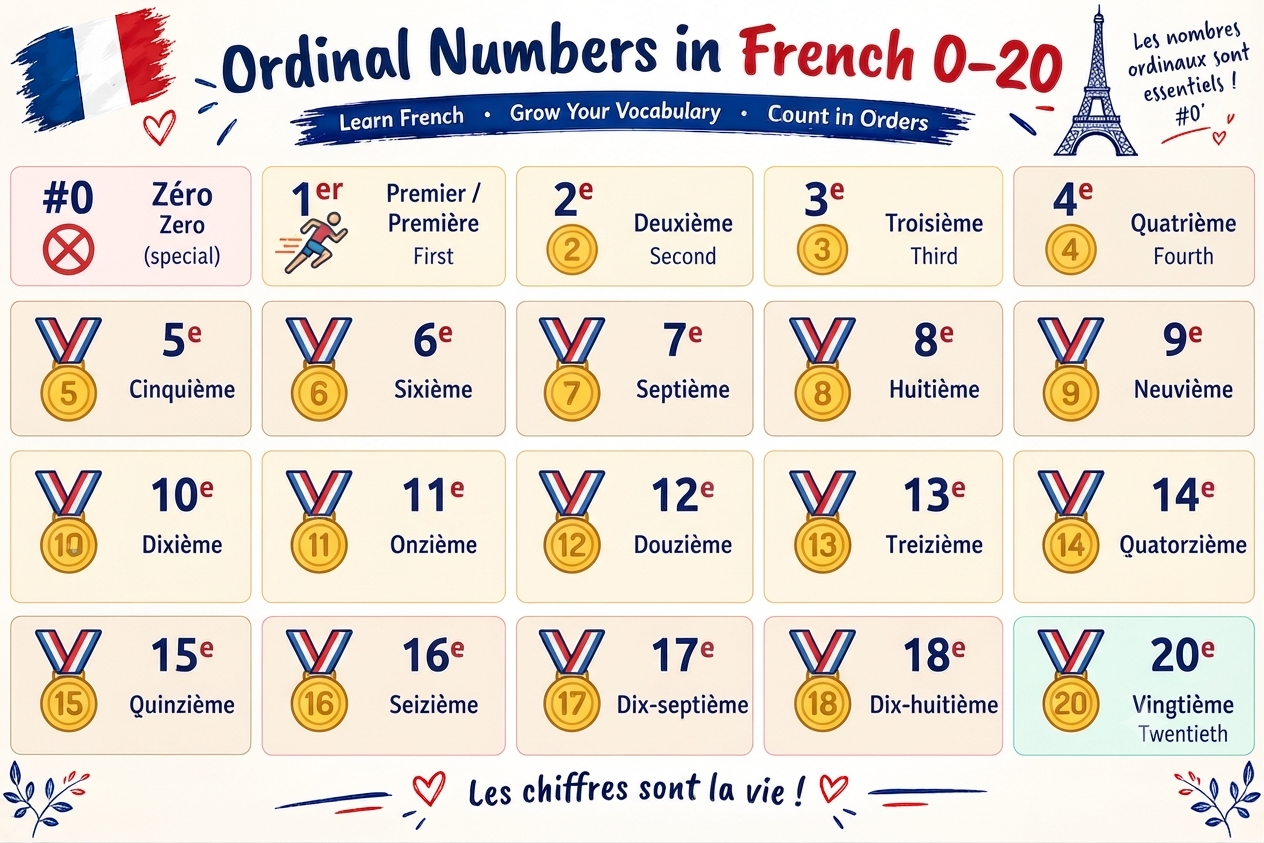
What Are Ordinal Numbers in French?
Ordinal numbers describe the position or order of something rather than its quantity. For example, “three” tells us how many there are, while “third” tells us the position.
In French:
- Trois = three
- Troisième = third
Most French ordinal numbers are formed by adding -ième to the cardinal number. However, there are a few important exceptions, particularly premier and première for “first.”
French Ordinal Numbers 0–20
| Number | French Ordinal Number | Pronunciation | English |
|---|---|---|---|
| 0 | zéroième* | zay-roh-YEM | zeroth |
| 1 | premier / première | pruh-MYAY / pruh-MYAIR | first |
| 2 | deuxième | duh-ZYEM | second |
| 3 | troisième | trwah-ZYEM | third |
| 4 | quatrième | ka-tree-YEM | fourth |
| 5 | cinquième | sank-YEM | fifth |
| 6 | sixième | see-ZYEM | sixth |
| 7 | septième | sep-TYEM | seventh |
| 8 | huitième | weet-YEM | eighth |
| 9 | neuvième | nuh-VYEM | ninth |
| 10 | dixième | dee-ZYEM | tenth |
| 11 | onzième | on-ZYEM | eleventh |
| 12 | douzième | doo-ZYEM | twelfth |
| 13 | treizième | treh-ZYEM | thirteenth |
| 14 | quatorzième | kah-TOR-ZYEM | fourteenth |
| 15 | quinzième | kan-ZYEM | fifteenth |
| 16 | seizième | say-ZYEM | sixteenth |
| 17 | dix-septième | dee-set-YEM | seventeenth |
| 18 | dix-huitième | dee-ZWEET-YEM | eighteenth |
| 19 | dix-neuvième | dee-z-nuh-VYEM | nineteenth |
| 20 | vingtième | van-TYEM | twentieth |
* Zéroième is technically possible but uncommon in everyday French. In most practical contexts, French speakers use other expressions rather than referring to something as “zeroth.”
Important Rules for French Ordinal Numbers
Most French ordinal numbers are relatively easy to form. Usually, you take the cardinal number and add -ième.
For example:
- quatre → quatrième
- six → sixième
- dix → dixième
- vingt → vingtième
However, five changes slightly:
cinq → cinquième
The spelling changes because cinqième is not correct.
The most important exception is premier, meaning “first.” When referring to a feminine noun, it becomes première.
For example:
- le premier jour = the first day
- la première semaine = the first week
How to Use French Ordinal Numbers in Sentences
Ordinal numbers are commonly used to describe order or position.
C’est mon premier jour.
= It is my first day.
Elle habite au deuxième étage.
= She lives on the second floor.
Il est arrivé troisième.
= He finished third.
Nous sommes au dixième chapitre.
= We are on the tenth chapter.
These examples show why learning ordinal numbers is useful for everyday French communication.
Ordinal Numbers and Dates
French ordinal numbers are particularly important when talking about the first day of the month. The number one is commonly expressed as premier in dates.
For example:
Le premier mai
= May 1st
For other dates, French normally uses cardinal numbers rather than ordinal numbers.
For example:
Le deux mai
= May 2nd
Le quinze juin
= June 15th
Therefore, beginners should remember that premier has a special role when expressing the first day of a month.
Final Thoughts
Understanding French ordinal numbers from 0 to 20 gives beginners useful vocabulary for talking about sequence, rankings, dates, floors, chapters, and positions. Most ordinal numbers follow a simple -ième pattern, but words such as premier, cinquième, and neuvième require special attention.
Practice saying each number aloud and use them in short sentences. With regular repetition, these French ordinal numbers will quickly become part of your everyday vocabulary.