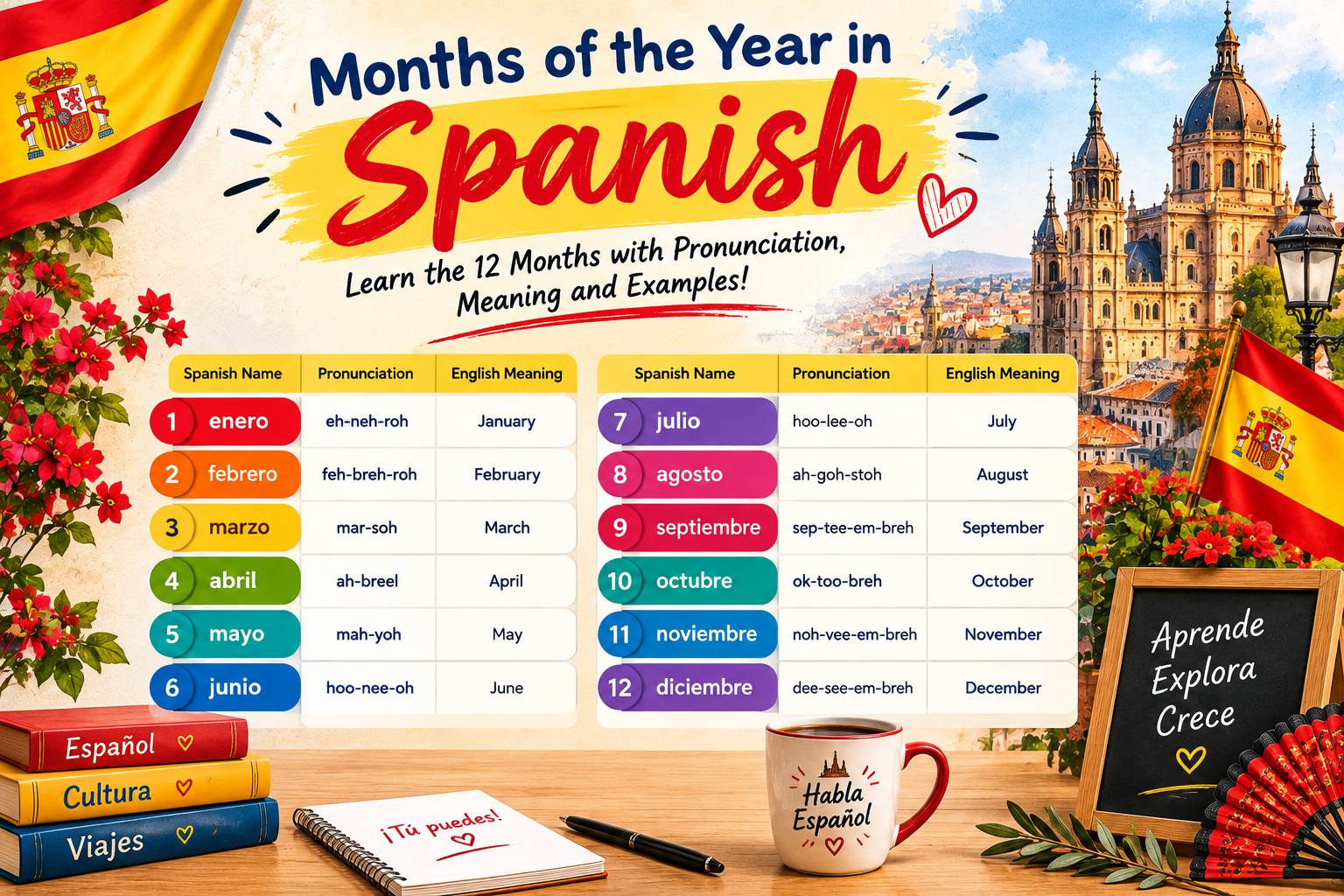
Months of the Year in Spanish
Names, Pronunciation and English Translation
Learning the months of the year is an important step for anyone studying Spanish. These words help you talk about birthdays, holidays, seasons, travel plans, appointments, school schedules, and important dates.
Fortunately, the Spanish names for the months are quite easy to learn. Many of them look similar to their English equivalents, which makes memorization easier for beginners. In this guide, you will learn all twelve months with their Spanish names, pronunciation, English meanings, examples, and useful grammar rules.
Months of the Year in Spanish Language
Here is a complete list of the twelve months:
| Spanish Name | Pronunciation | English Translation |
|---|---|---|
| enero | eh-neh-roh | January |
| febrero | feh-breh-roh | February |
| marzo | mar-soh | March |
| abril | ah-breel | April |
| mayo | mah-yoh | May |
| junio | hoo-nee-oh | June |
| julio | hoo-lee-oh | July |
| agosto | ah-goh-stoh | August |
| septiembre | sep-tee-em-breh | September |
| octubre | ok-too-breh | October |
| noviembre | noh-vee-em-breh | November |
| diciembre | dee-see-em-breh | December |
1. Enero – January
Enero means January. It is the first month of the calendar year. The word is usually written in lowercase because Spanish month names do not normally begin with capital letters.
For example:
Mi cumpleaños es en enero.
My birthday is in January.
2. Febrero – February
Febrero means February. It is easy to recognize because it closely resembles the English word “February.”
For example:
Febrero es un mes corto.
February is a short month.
3. Marzo – March
Marzo means March. The pronunciation is slightly different from the English pronunciation, so listen carefully when practicing.
For example:
Las clases empiezan en marzo.
Classes begin in March.
4. Abril – April
Abril means April. The word is short and easy to remember because it has a similar form to the English word.
For example:
Viajo a España en abril.
I travel to Spain in April.
5. Mayo – May
Mayo means May. Remember that the Spanish y has a sound that can vary slightly depending on the speaker and region.
For example:
Mayo es un mes agradable.
May is a pleasant month.
6. Junio – June
Junio means June. The word contains three syllables, which makes it useful to practice slowly at first.
For example:
El verano comienza en junio.
Summer begins in June.
7. Julio – July
Julio means July. Although it looks similar to the English word “July,” the Spanish pronunciation is different.
For example:
Mi familia viaja en julio.
My family travels in July.
8. Agosto – August
Agosto means August. This word is commonly used when talking about summer holidays and travel.
For example:
Agosto es muy caluroso.
August is very hot.
9. Septiembre – September
Septiembre means September. You may also encounter setiembre in some Spanish-speaking regions. However, septiembre is widely used and is the standard form learners will commonly encounter.
For example:
La escuela comienza en septiembre.
School begins in September.
10. Octubre – October
Octubre means October. The Spanish word looks very similar to its English equivalent, making it easy to recognize.
For example:
Halloween es en octubre.
Halloween is in October.
11. Noviembre – November
Noviembre means November. Practice the middle syllables carefully because the Spanish pronunciation differs from English.
For example:
El clima cambia en noviembre.
The weather changes in November.
12. Diciembre – December
Diciembre means December. It is the final month of the calendar year.
For example:
La Navidad es en diciembre.
Christmas is in December.
How to Use Months in Spanish
One of the most useful words to learn with the months is en, which usually means “in” when talking about months.
For example:
en enero — in January
en marzo — in March
en agosto — in August
en diciembre — in December
You can use this structure to talk about events, birthdays, holidays, and plans.
Examples
Nací en junio.
I was born in June.
Tenemos vacaciones en agosto.
We have holidays in August.
La universidad comienza en septiembre.
The university begins in September.
Mi cumpleaños es en diciembre.
My birthday is in December.
Do Spanish Months Start With Capital Letters?
No. In Spanish, the names of months are normally written with lowercase letters.
English:
January, February, March
Spanish:
enero, febrero, marzo
Therefore, you should write:
Mi cumpleaños es en enero.
Not:
Mi cumpleaños es en Enero.
This is an important difference for English speakers learning Spanish.
Months and Articles in Spanish
When talking about a particular month, Spanish speakers can use an article depending on the sentence.
For example:
El mes de enero es frío.
The month of January is cold.
Here, el mes de enero literally means “the month of January.”
However, when simply saying that something happens in a month, en is commonly used:
Viajo en julio.
I travel in July.
How to Ask About a Month in Spanish
You can use several simple questions when practicing.
What month is it?
¿Qué mes es?
What month is your birthday?
¿En qué mes es tu cumpleaños?
When is your birthday?
¿Cuándo es tu cumpleaños?
What month comes after March?
¿Qué mes viene después de marzo?
These questions are useful for practicing vocabulary in everyday conversations.
Seasons and Months in Spanish
Knowing the seasons can make it easier to remember the months.
| Season | Spanish | Common Months |
|---|---|---|
| Spring | primavera | marzo, abril, mayo |
| Summer | verano | junio, julio, agosto |
| Autumn/Fall | otoño | septiembre, octubre, noviembre |
| Winter | invierno | diciembre, enero, febrero |
Keep in mind that seasons can differ depending on whether you are talking about the Northern or Southern Hemisphere.
Easy Sentences to Practice
Try reading these sentences aloud:
- Enero es el primer mes del año. — January is the first month of the year.
- Febrero tiene menos días que otros meses. — February has fewer days than other months.
- Marzo viene después de febrero. — March comes after February.
- Abril tiene treinta días. — April has thirty days.
- Mayo viene antes de junio. — May comes before June.
- Junio es un mes de verano. — June is a summer month.
- Julio es después de junio. — July comes after June.
- Agosto es el octavo mes. — August is the eighth month.
- Septiembre viene después de agosto. — September comes after August.
- Octubre es el décimo mes. — October is the tenth month.
- Noviembre viene antes de diciembre. — November comes before December.
- Diciembre es el último mes del año. — December is the last month of the year.
Tips to Memorize the Months
Learning twelve new vocabulary words may seem difficult at first. However, a few simple techniques can make the process easier.
Practice in Groups
Learn four months at a time:
enero – febrero – marzo – abril
Then practice:
mayo – junio – julio – agosto
Finally:
septiembre – octubre – noviembre – diciembre
Use a Calendar
Look at a Spanish calendar and say the month aloud whenever you check a date. This connects the vocabulary with a real-life activity.
Create Personal Sentences
Use your own birthday, holidays, or travel plans.
For example:
Mi cumpleaños es en mayo.
My birthday is in May.
Personal examples are often easier to remember than isolated vocabulary.
Conclusion
Learning the months of the year in Spanish gives beginners useful vocabulary for everyday conversations. The twelve names are enero, febrero, marzo, abril, mayo, junio, julio, agosto, septiembre, octubre, noviembre, and diciembre.
Remember one important grammar rule: Spanish month names are normally written in lowercase. Also, use en when talking about something happening during a particular month.
With regular practice, you can quickly use these words to discuss birthdays, holidays, seasons, school schedules, travel, and important dates in Spanish.
Frequently Asked Questions About Months in Spanish
1. How do you say January in Spanish?
January is enero in Spanish.
Example: Mi cumpleaños es en enero. — My birthday is in January.
2. How do you say February in Spanish?
February is febrero in Spanish.
Example: Febrero es un mes corto. — February is a short month.
3. How do you say March in Spanish?
March is marzo in Spanish.
Example: Las clases empiezan en marzo. — Classes begin in March.
4. How do you say April in Spanish?
April is abril in Spanish.
Example: Viajo en abril. — I travel in April.
5. How do you say May in Spanish?
May is mayo in Spanish.
Example: Mayo viene después de abril. — May comes after April.
6. How do you say June in Spanish?
June is junio in Spanish.
Example: El verano comienza en junio. — Summer begins in June.
7. How do you say July in Spanish?
July is julio in Spanish.
Example: Mi familia viaja en julio. — My family travels in July.
8. How do you say August in Spanish?
August is agosto in Spanish.
Example: Tenemos vacaciones en agosto. — We have holidays in August.
9. How do you say September in Spanish?
September is septiembre in Spanish.
Example: La escuela comienza en septiembre. — School begins in September.
10. How do you say October in Spanish?
October is octubre in Spanish.
Example: Halloween es en octubre. — Halloween is in October.
11. How do you say November in Spanish?
November is noviembre in Spanish.
Example: El clima cambia en noviembre. — The weather changes in November.
12. How do you say December in Spanish?
December is diciembre in Spanish.
Example: La Navidad es en diciembre. — Christmas is in December.
13. What are the 12 months in Spanish?
The twelve months are enero, febrero, marzo, abril, mayo, junio, julio, agosto, septiembre, octubre, noviembre, and diciembre.
14. Do Spanish months begin with capital letters?
No. Spanish month names are normally written in lowercase, such as enero and diciembre.
15. How do you say “in January” in Spanish?
“In January” is en enero in Spanish.
16. How do you ask “What month is it?” in Spanish?
You can say ¿Qué mes es?
17. How do you ask “What month is your birthday?” in Spanish?
You can say ¿En qué mes es tu cumpleaños?
18. What is the Spanish word for month?
The Spanish word for “month” is mes.
19. What is the Spanish word for year?
The Spanish word for “year” is año.
20. What is the easiest way to memorize the months in Spanish?
Practice the twelve names in order and use them in short sentences. You can also write the months on a calendar and say each one aloud while studying.