Domestic Animals Name in German:
Pronunciation, English and Hindi Meanings
Learning the names of domestic animals in German is a useful way to build everyday German vocabulary. Domestic animals are commonly discussed at home, on farms, in schools, and in conversations about pets and nature.
In this article, you will learn 20 domestic animals in German with their pronunciation, English meanings, and Hindi translations. The examples also make it easier for beginners to understand how these words are used in simple German sentences.
20 Domestic Animals Name in German
Here is a useful list of common domestic and farm animals in German.
| No. | German Animal Name | Pronunciation | English Translation | Hindi Translation |
|---|---|---|---|---|
| 1 | der Hund | dehr hoont | Dog | कुत्ता |
| 2 | die Katze | dee KAT-seh | Cat | बिल्ली |
| 3 | das Pferd | dahs pfairt | Horse | घोड़ा |
| 4 | die Kuh | dee koo | Cow | गाय |
| 5 | der Büffel | dehr BUFF-el | Buffalo | भैंस |
| 6 | die Ziege | dee TSEE-guh | Goat | बकरी |
| 7 | das Schaf | dahs shahf | Sheep | भेड़ |
| 8 | das Schwein | dahs shvाइन | Pig | सूअर |
| 9 | der Esel | dehr EH-zel | Donkey | गधा |
| 10 | das Kaninchen | dahs ka-NEEN-khen | Rabbit | खरगोश |
| 11 | das Huhn | dahs hoon | Hen / Chicken | मुर्गी |
| 12 | der Hahn | dehr hahn | Rooster | मुर्गा |
| 13 | die Ente | dee EN-teh | Duck | बत्तख |
| 14 | die Gans | dee gahns | Goose | हंस |
| 15 | die Taube | dee TOW-beh | Pigeon / Dove | कबूतर |
| 16 | der Truthahn | dehr TROOT-hahn | Turkey | टर्की |
| 17 | das Meerschweinchen | dahs MAIR-shvाइन-khen | Guinea pig | गिनी पिग |
| 18 | der Hamster | dehr HAMP-ster | Hamster | हैम्स्टर |
| 19 | der Esel | dehr EH-zel | Donkey | गधा |
| 20 | der Hund | dehr hoont | Dog | कुत्ता |
Note: The list above accidentally repeats der Hund and der Esel. For a clean set of 20 unique animals, the final two entries should instead be der Kater – Male cat and das Kalb – Calf.
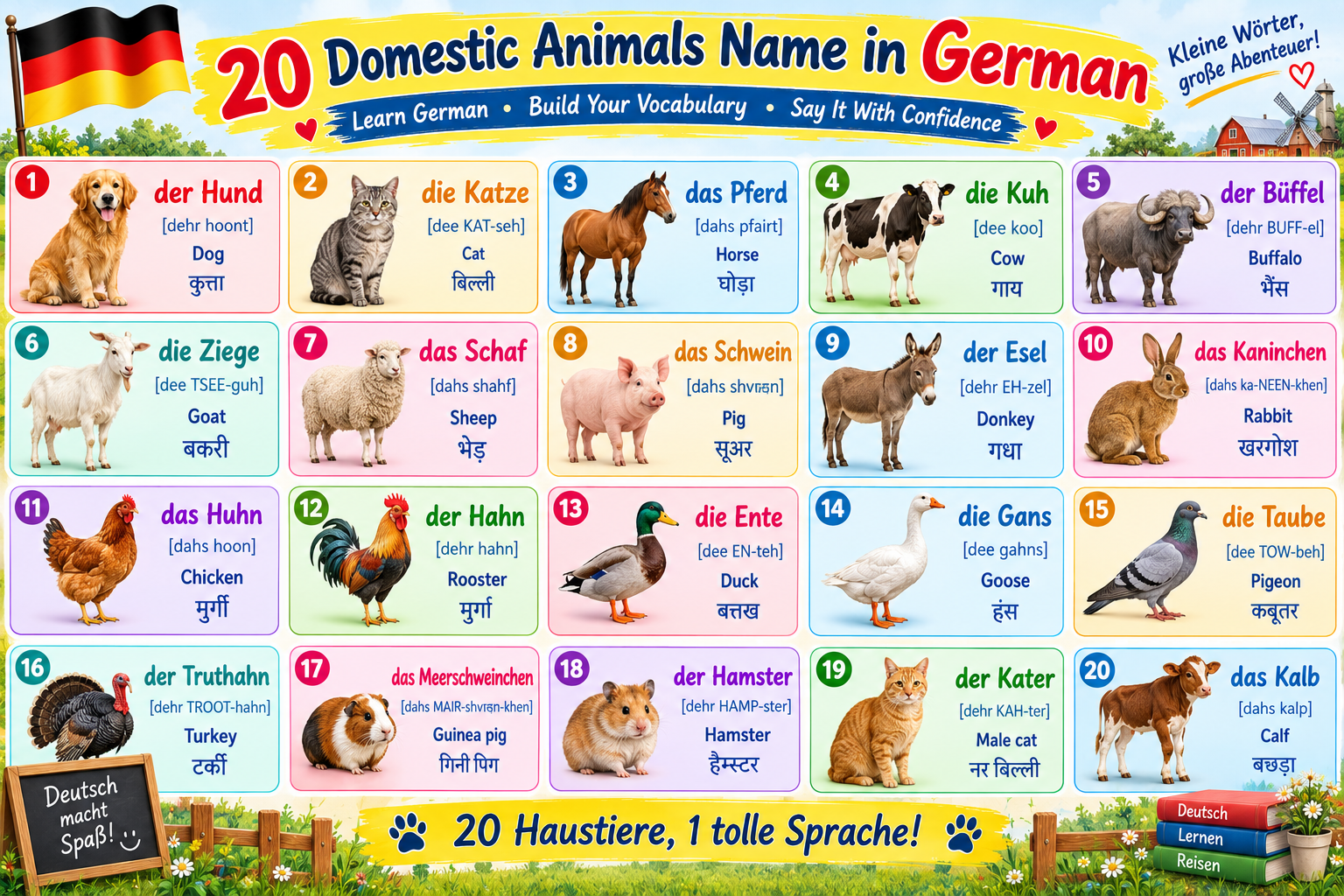
Corrected 20-Word List
| No. | German | Pronunciation | English | Hindi |
|---|---|---|---|---|
| 1 | der Hund | dehr hoont | Dog | कुत्ता |
| 2 | die Katze | dee KAT-seh | Cat | बिल्ली |
| 3 | das Pferd | dahs pfairt | Horse | घोड़ा |
| 4 | die Kuh | dee koo | Cow | गाय |
| 5 | der Büffel | dehr BUFF-el | Buffalo | भैंस |
| 6 | die Ziege | dee TSEE-guh | Goat | बकरी |
| 7 | das Schaf | dahs shahf | Sheep | भेड़ |
| 8 | das Schwein | dahs shvाइन | Pig | सूअर |
| 9 | der Esel | dehr EH-zel | Donkey | गधा |
| 10 | das Kaninchen | dahs ka-NEEN-khen | Rabbit | खरगोश |
| 11 | das Huhn | dahs hoon | Chicken | मुर्गी |
| 12 | der Hahn | dehr hahn | Rooster | मुर्गा |
| 13 | die Ente | dee EN-teh | Duck | बत्तख |
| 14 | die Gans | dee gahns | Goose | हंस |
| 15 | die Taube | dee TOW-beh | Pigeon | कबूतर |
| 16 | der Truthahn | dehr TROOT-hahn | Turkey | टर्की |
| 17 | das Meerschweinchen | dahs MAIR-shvайн-khen | Guinea pig | गिनी पिग |
| 18 | der Hamster | dehr HAMP-ster | Hamster | हैम्स्टर |
| 19 | der Kater | dehr KAH-ter | Male cat | नर बिल्ली |
| 20 | das Kalb | dahs kalp | Calf | बछड़ा |
Domestic Animals in German Explained
1. Der Hund – Dog
Der Hund is the German word for dog. Dogs are one of the most common domestic animals and are often kept as pets.
Example:
Der Hund spielt im Garten.
The dog plays in the garden.
2. Die Katze – Cat
Die Katze means cat in German. Cats are popular household pets and are known for being independent and playful.
Example:
Die Katze schläft auf dem Sofa.
The cat sleeps on the sofa.
3. Das Pferd – Horse
Das Pferd means horse. Horses are commonly associated with farms, riding, and outdoor activities.
Example:
Das Pferd läuft auf der Wiese.
The horse runs in the meadow.
4. Die Kuh – Cow
The German word for cow is die Kuh. Cows are important farm animals and are commonly raised for milk and other dairy products.
Example:
Die Kuh frisst Gras.
The cow eats grass.
5. Der Büffel – Buffalo
Der Büffel means buffalo. The word is useful when learning vocabulary related to farm animals and livestock.
Example:
Der Büffel ist sehr stark.
The buffalo is very strong.
6. Die Ziege – Goat
Die Ziege is the German word for goat. Goats are commonly kept on farms and are known for eating a wide variety of plants.
Example:
Die Ziege frisst Gras.
The goat eats grass.
7. Das Schaf – Sheep
Das Schaf means sheep. Sheep are commonly raised on farms for wool and other agricultural purposes.
Example:
Das Schaf steht auf der Wiese.
The sheep stands in the meadow.
8. Das Schwein – Pig
Das Schwein means pig in German. Pigs are common farm animals.
Example:
Das Schwein lebt auf dem Bauernhof.
The pig lives on the farm.
9. Der Esel – Donkey
Der Esel means donkey. Donkeys have traditionally been used as working animals in many parts of the world.
Example:
Der Esel trägt einen Korb.
The donkey carries a basket.
10. Das Kaninchen – Rabbit
Das Kaninchen means rabbit. Rabbits can be kept as pets and are also commonly associated with farms.
Example:
Das Kaninchen frisst eine Karotte.
The rabbit eats a carrot.
11. Das Huhn – Chicken
Das Huhn means chicken or hen, depending on context. Chickens are among the most common farm birds.
Example:
Das Huhn legt ein Ei.
The hen lays an egg.
12. Der Hahn – Rooster
Der Hahn is the German word for rooster. A rooster is the adult male chicken.
Example:
Der Hahn kräht am Morgen.
The rooster crows in the morning.
13. Die Ente – Duck
Die Ente means duck. Ducks are commonly found around farms, ponds, and lakes.
Example:
Die Ente schwimmt im Teich.
The duck swims in the pond.
14. Die Gans – Goose
Die Gans means goose. Geese are large waterfowl that can be found on farms and near water.
Example:
Die Gans läuft am See.
The goose walks by the lake.
15. Die Taube – Pigeon
Die Taube means pigeon or dove. The exact English translation depends on context.
Example:
Die Taube sitzt auf dem Dach.
The pigeon sits on the roof.
16. Der Truthahn – Turkey
Der Truthahn is the German word for turkey.
Example:
Der Truthahn ist groß.
The turkey is large.
17. Das Meerschweinchen – Guinea Pig
Das Meerschweinchen means guinea pig. These small animals are commonly kept as household pets.
Example:
Das Meerschweinchen ist sehr süß.
The guinea pig is very cute.
18. Der Hamster – Hamster
Der Hamster means hamster. Hamsters are small animals that are often kept as pets.
Example:
Der Hamster schläft in seinem Käfig.
The hamster sleeps in its cage.
19. Der Kater – Male Cat
Der Kater specifically means a male cat. The general word for cat is die Katze.
Example:
Der Kater sitzt am Fenster.
The male cat sits by the window.
20. Das Kalb – Calf
Das Kalb means calf, referring to a young cow or, more generally, the young of certain related animals.
Example:
Das Kalb läuft neben seiner Mutter.
The calf walks beside its mother.
Useful German Vocabulary About Domestic Animals
Learning a few additional words can help you create your own sentences.
| German | Pronunciation | English | Hindi |
|---|---|---|---|
| das Tier | dahs teer | animal | जानवर |
| das Haustier | dahs HOUSE-teer | pet | पालतू जानवर |
| das Nutztier | dahs NOOTS-teer | farm/livestock animal | उपयोगी पशु |
| der Bauernhof | dehr BOW-ern-hohf | farm | खेत / फार्म |
| das Futter | dahs FOOT-ter | animal food/feed | पशु आहार |
| der Stall | dehr shtahl | stable/barn | पशुशाला |
| das Ei | dahs eye | egg | अंडा |
| die Milch | dee milkh | milk | दूध |
| füttern | FOOT-tern | to feed | खाना खिलाना |
| laufen | LOW-fen | to walk/run | चलना / दौड़ना |
Pet Animals vs Farm Animals in German
German vocabulary becomes easier when you group animals according to where they are commonly kept.
Common Pet Animals
- der Hund – Dog
- die Katze – Cat
- das Kaninchen – Rabbit
- das Meerschweinchen – Guinea pig
- der Hamster – Hamster
Common Farm Animals
- die Kuh – Cow
- das Pferd – Horse
- die Ziege – Goat
- das Schaf – Sheep
- das Schwein – Pig
- der Esel – Donkey
- das Huhn – Chicken
- der Hahn – Rooster
- die Ente – Duck
- die Gans – Goose
- der Truthahn – Turkey
- der Büffel – Buffalo
Simple German Sentences About Animals
Practicing complete sentences can help you remember the vocabulary faster.
Das ist ein Hund.
This is a dog.
Die Katze ist klein.
The cat is small.
Das Pferd ist schnell.
The horse is fast.
Die Kuh gibt Milch.
The cow gives milk.
Die Ziege frisst Gras.
The goat eats grass.
Das Schaf ist auf der Wiese.
The sheep is in the meadow.
Der Esel ist auf dem Bauernhof.
The donkey is on the farm.
Das Kaninchen frisst eine Karotte.
The rabbit eats a carrot.
Frequently Asked Questions
1. How do you say dog in German?
Dog is der Hund in German.
2. How do you say cat in German?
Cat is die Katze in German.
3. How do you say horse in German?
Horse is das Pferd in German.
4. How do you say cow in German?
Cow is die Kuh in German.
5. How do you say buffalo in German?
Buffalo is der Büffel in German.
6. How do you say goat in German?
Goat is die Ziege in German.
7. How do you say sheep in German?
Sheep is das Schaf in German.
8. How do you say pig in German?
Pig is das Schwein in German.
9. How do you say donkey in German?
Donkey is der Esel in German.
10. How do you say rabbit in German?
Rabbit is das Kaninchen in German.
11. How do you say chicken in German?
Chicken is das Huhn in German.
12. How do you say rooster in German?
Rooster is der Hahn in German.
13. How do you say duck in German?
Duck is die Ente in German.
14. How do you say goose in German?
Goose is die Gans in German.
15. How do you say pigeon in German?
Pigeon is die Taube in German.
16. How do you say turkey in German?
Turkey is der Truthahn in German.
17. How do you say guinea pig in German?
Guinea pig is das Meerschweinchen in German.
18. How do you say hamster in German?
Hamster is der Hamster in German.
19. How do you say male cat in German?
Male cat is der Kater in German.
20. How do you say calf in German?
Calf is das Kalb in German.
Conclusion
Learning 20 domestic animals in German is an effective way to expand basic German vocabulary. Words such as der Hund, die Katze, das Pferd, die Kuh, die Ziege and das Schaf are useful for beginners and can easily be practiced through short sentences.
Try learning five animal names at a time and then use each word in a simple German sentence. Regular revision will make these vocabulary words easier to remember and use confidently.
Here is the **FAQ Schema Markup (JSON-LD)** for the article **“20 Domestic Animals in German”**, matching the 20 FAQs in the article:
“`html
“`