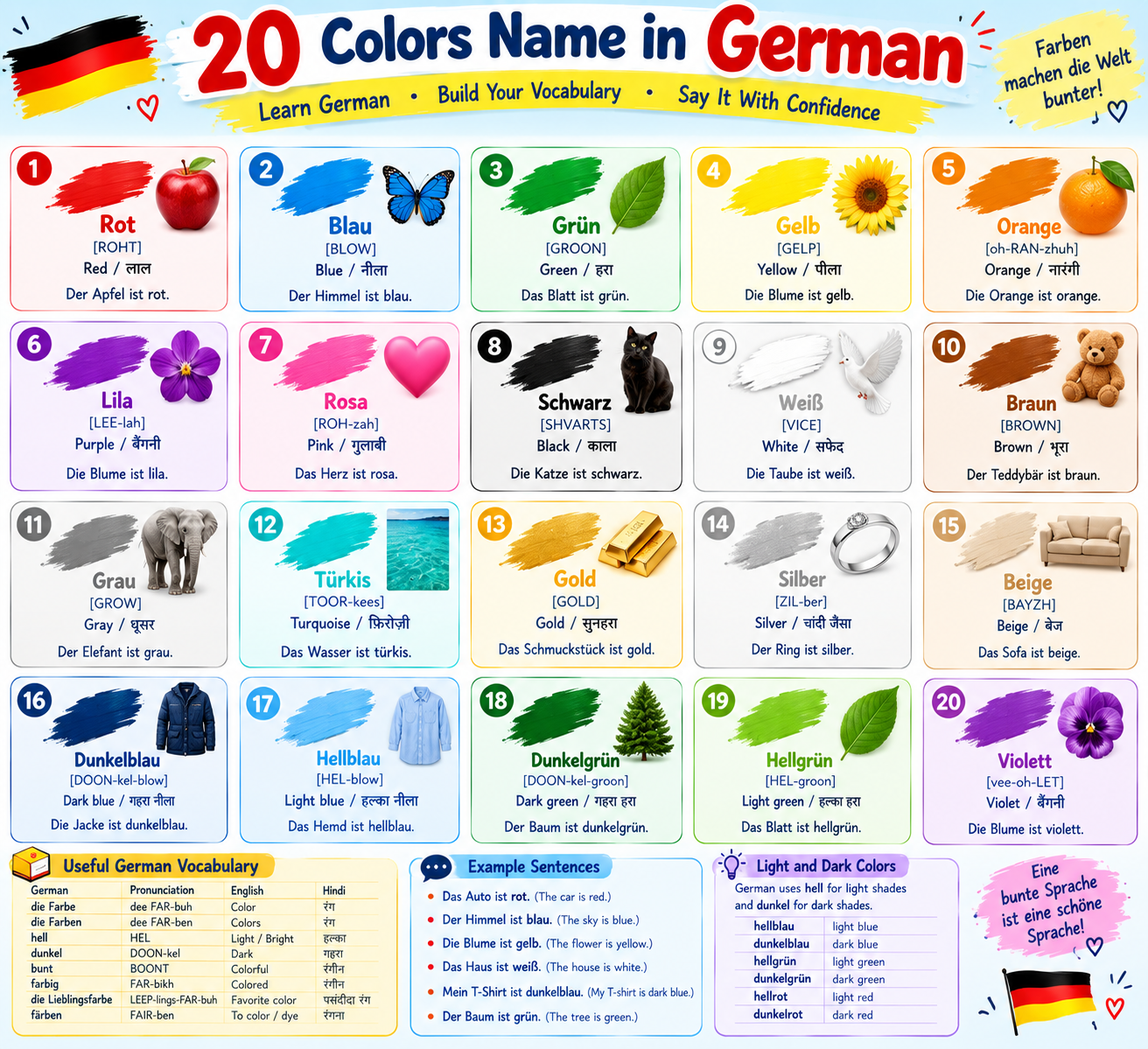
German Colors with Pronunciation, English and Hindi Meanings
Learning colors name in German is an important part of building basic German vocabulary. Colors are used in everyday conversations when describing clothes, objects, animals, food, places, and surroundings.
In this article, you will learn 20 common colors in German with their pronunciation, English meaning, Hindi translation, and simple example sentences.
20 Colors Name in German
No.
German Color
Pronunciation
English Translation
Hindi Translation
1
Rot
ROHT
Red
लाल
2
Blau
BLOW
Blue
नीला
3
Grün
GROON
Green
हरा
4
Gelb
GELP
Yellow
पीला
5
Orange
oh-RAN-zhuh
Orange
नारंगी
6
Lila
LEE-lah
Purple
बैंगनी
7
Rosa
ROH-zah
Pink
गुलाबी
8
Schwarz
SHVARTS
Black
काला
9
Weiß
VICE
White
सफेद
10
Braun
BROWN
Brown
भूरा
11
Grau
GROW
Gray
धूसर / ग्रे
12
Türkis
TOOR-kees
Turquoise
फ़िरोज़ी
13
Gold
GOLD
Gold
सुनहरा
14
Silber
ZIL-ber
Silver
चांदी जैसा
15
Beige
BAYZH
Beige
बेज
16
Dunkelblau
DOON-kel-blow
Dark blue
गहरा नीला
17
Hellblau
HEL-blow
Light blue
हल्का नीला
18
Dunkelgrün
DOON-kel-groon
Dark green
गहरा हरा
19
Hellgrün
HEL-groon
Light green
हल्का हरा
20
Violett
vee-oh-LET
Violet
बैंगनी
colors name in german language
Note: The pronunciations are simplified guides for beginners. German pronunciation can vary slightly by region.
German Colors Explained
1. Rot – Red
Rot means red in German. It is commonly used to describe objects, clothing, flowers, vehicles, and signs.
Example: Der Apfel ist rot.
The apple is red.
2. Blau – Blue
Blau means blue. It can describe the sky, water, clothes, and many other objects.
Example: Der Himmel ist blau.
The sky is blue.
3. Grün – Green
Grün means green. It is often associated with plants, trees, and nature.
Example: Das Gras ist grün.
The grass is green.
4. Gelb – Yellow
Gelb means yellow in German. It can be used to describe flowers, fruits, clothes, and objects.
Example: Die Blume ist gelb.
The flower is yellow.
5. Orange – Orange
Orange means orange. The German word is very similar to the English word.
Example: Die Orange ist orange.
The orange is orange.
6. Lila – Purple
Lila means purple. It is frequently used when describing clothes, flowers, and decorative objects.
Example: Das Kleid ist lila.
The dress is purple.
7. Rosa – Pink
Rosa means pink in German.
Example: Die Blume ist rosa.
The flower is pink.
8. Schwarz – Black
Schwarz means black. It is one of the most common color words in German.
Example: Das Auto ist schwarz.
The car is black.
9. Weiß – White
Weiß means white.
Example: Der Schnee ist weiß.
The snow is white.
10. Braun – Brown
Braun means brown. It is commonly used for describing wood, animals, shoes, and clothing.
Example: Der Hund ist braun.
The dog is brown.
11. Grau – Gray
Grau means gray.
Example: Der Himmel ist grau.
The sky is gray.
12. Türkis – Turquoise
Türkis means turquoise, a color between blue and green.
Example: Das Wasser ist türkis.
The water is turquoise.
13. Gold – Gold
Gold means gold or golden. It is often used for jewelry, decorations, and valuable objects.
Example: Die Kette ist gold.
The necklace is gold.
14. Silber – Silver
Silber means silver.
Example: Das Auto ist silber.
The car is silver.
15. Beige – Beige
Beige means beige and is especially common when describing clothing, furniture, and interior colors.
Example: Das Sofa ist beige.
The sofa is beige.
16. Dunkelblau – Dark Blue
Dunkelblau literally means “dark blue.” It combines dunkel (dark) with blau (blue).
Example: Meine Jacke ist dunkelblau.
My jacket is dark blue.
17. Hellblau – Light Blue
Hellblau means light blue. Hell means light or bright.
Example: Das Hemd ist hellblau.
The shirt is light blue.
18. Dunkelgrün – Dark Green
Dunkelgrün means dark green.
Example: Der Mantel ist dunkelgrün.
The coat is dark green.
19. Hellgrün – Light Green
Hellgrün means light green.
Example: Das Blatt ist hellgrün.
The leaf is light green.
20. Violett – Violet
Violett means violet. It is a common color term and is closely related to purple.
Example: Die Blume ist violett.
The flower is violet.
How to Use Colors in German Sentences
Colors can work as adjectives in German. When a color describes a noun, its ending can change depending on the grammatical structure.
For beginners, simple sentences are a good place to start:
Das Auto ist rot.
The car is red.
Die Tasche ist schwarz.
The bag is black.
Der Ball ist blau.
The ball is blue.
Das Haus ist weiß.
The house is white.
Notice that after sein (to be), the basic color form is normally used.
Light and Dark Colors in German
German uses hell for light shades and dunkel for dark shades.
German
English
Hindi
hellblau
light blue
हल्का नीला
dunkelblau
dark blue
गहरा नीला
hellgrün
light green
हल्का हरा
dunkelgrün
dark green
गहरा हरा
hellrot
light red
हल्का लाल
dunkelrot
dark red
गहरा लाल
hellgelb
light yellow
हल्का पीला
dunkelgelb
dark yellow
गहरा पीला
This is a useful pattern because you can create many additional color descriptions.
Useful German Vocabulary Related to Colors
German
Pronunciation
English
Hindi
die Farbe
dee FAR-buh
Color
रंग
die Farben
dee FAR-ben
Colors
रंग
hell
HEL
Light / Bright
हल्का
dunkel
DOON-kel
Dark
गहरा
bunt
BOONT
Colorful
रंगीन
farbig
FAR-bikh
Colored
रंगीन
die Lieblingsfarbe
LEEP-lings-FAR-buh
Favorite color
पसंदीदा रंग
färben
FAIR-ben
To color / dye
रंगना
Colors in Everyday German
Colors are useful in many everyday situations. You can use them when shopping for clothes, describing your home, talking about food, or identifying objects.
For example:
Ich mag Blau.
I like blue.
Meine Lieblingsfarbe ist Grün.
My favorite color is green.
Welche Farbe hat das Auto?
What color is the car?
Das Auto ist Rot. ❌ Das Auto ist rot. ✅
When a color is used as a predicate after sein, it is normally written in lowercase because it is an adjective.
Quick Revision: 20 Colors in German
Rot – Red
Blau – Blue
Grün – Green
Gelb – Yellow
Orange – Orange
Lila – Purple
Rosa – Pink
Schwarz – Black
Weiß – White
Braun – Brown
Grau – Gray
Türkis – Turquoise
Gold – Gold
Silber – Silver
Beige – Beige
Dunkelblau – Dark blue
Hellblau – Light blue
Dunkelgrün – Dark green
Hellgrün – Light green
Violett – Violet
Frequently Asked Questions
1. How do you say color in German?
Color is die Farbe in German.
2. How do you say red in German?
Red is rot in German.
3. How do you say blue in German?
Blue is blau in German.
4. How do you say green in German?
Green is grün in German.
5. How do you say yellow in German?
Yellow is gelb in German.
6. How do you say orange in German?
Orange is orange in German.
7. How do you say purple in German?
Purple can be lila or violett in German.
8. How do you say pink in German?
Pink is rosa in German.
9. How do you say black in German?
Black is schwarz in German.
10. How do you say white in German?
White is weiß in German.
11. How do you say brown in German?
Brown is braun in German.
12. How do you say gray in German?
Gray is grau in German.
13. How do you say turquoise in German?
Turquoise is türkis in German.
14. How do you say gold in German?
Gold is gold in German.
15. How do you say silver in German?
Silver is silber in German.
16. How do you say light blue in German?
Light blue is hellblau in German.
17. How do you say dark blue in German?
Dark blue is dunkelblau in German.
18. How do you say light green in German?
Light green is hellgrün in German.
19. How do you say dark green in German?
Dark green is dunkelgrün in German.
20. What are the most common colors in German?
Some common German colors are rot, blau, grün, gelb, schwarz, weiß, braun, grau, rosa, lila, and orange.
Conclusion
Learning 20 colors name in German gives beginners useful vocabulary for everyday conversations. Colors such as rot, blau, grün, gelb, schwarz, weiß, and braun are especially important for describing objects and surroundings.
To improve your German, practice each color with a simple sentence and learn useful combinations such as hellblau for light blue and dunkelgrün for dark green. Regular revision will help you remember these German color names and use them naturally.