Cardinal Numbers in French
Cardinal Numbers 0–50: Pronunciation & English Translation
Learning cardinal numbers in French is one of the first steps toward building a strong French vocabulary. Whether you are talking about your age, counting objects, discussing prices, giving a phone number, or telling someone an address, French numbers are part of everyday communication.
This guide covers French cardinal numbers from 0 to 50, including easy pronunciation and English translations. It is designed for beginners who want a practical reference for learning and speaking French.
What Are Cardinal Numbers in French?
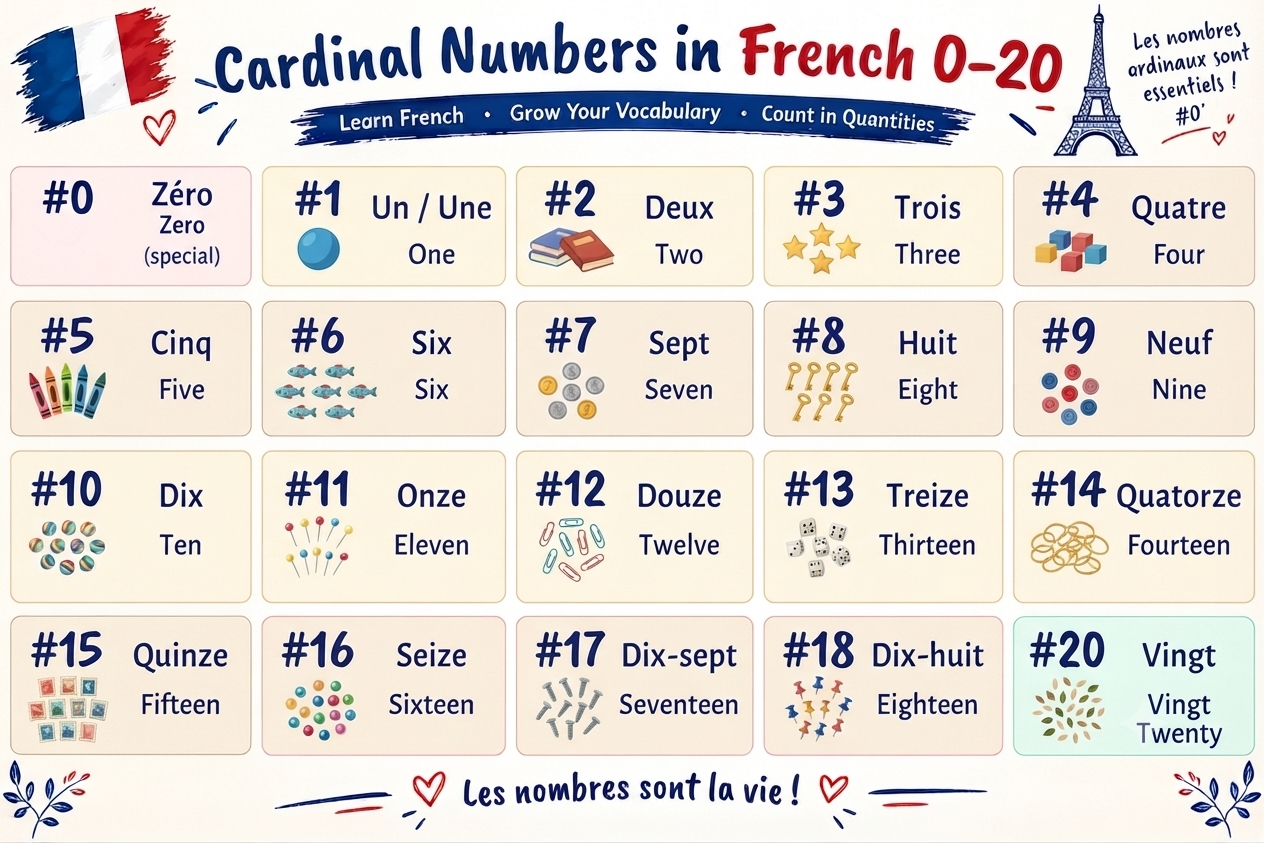
Cardinal numbers are numbers used to express quantity or amount. For example:
- un = one
- deux = two
- dix = ten
- vingt = twenty
They are different from ordinal numbers, which describe position or order, such as premier (first) or deuxième (second).
French Cardinal Numbers 0–50
| Number | French | Pronunciation | English |
|---|---|---|---|
| 0 | zéro | ZAY-roh | zero |
| 1 | un | uhn | one |
| 2 | deux | duh | two |
| 3 | trois | trwah | three |
| 4 | quatre | katr | four |
| 5 | cinq | sank | five |
| 6 | six | sees | six |
| 7 | sept | set | seven |
| 8 | huit | weet | eight |
| 9 | neuf | nuhf | nine |
| 10 | dix | dees | ten |
| 11 | onze | onz | eleven |
| 12 | douze | dooz | twelve |
| 13 | treize | trez | thirteen |
| 14 | quatorze | kah-TORZ | fourteen |
| 15 | quinze | kanz | fifteen |
| 16 | seize | sez | sixteen |
| 17 | dix-sept | dees-SET | seventeen |
| 18 | dix-huit | deez-WEET | eighteen |
| 19 | dix-neuf | deez-NUHF | nineteen |
| 20 | vingt | van | twenty |
| 21 | vingt et un | van-tay-uhn | twenty-one |
| 22 | vingt-deux | van-DUH | twenty-two |
| 23 | vingt-trois | van-TRWAH | twenty-three |
| 24 | vingt-quatre | van-KATR | twenty-four |
| 25 | vingt-cinq | van-SANK | twenty-five |
| 26 | vingt-six | van-SEES | twenty-six |
| 27 | vingt-sept | van-SET | twenty-seven |
| 28 | vingt-huit | van-WEET | twenty-eight |
| 29 | vingt-neuf | van-NUHF | twenty-nine |
| 30 | trente | trahnt | thirty |
| 31 | trente et un | trahnt-ay-uhn | thirty-one |
| 32 | trente-deux | trahnt-DUH | thirty-two |
| 33 | trente-trois | trahnt-TRWAH | thirty-three |
| 34 | trente-quatre | trahnt-KATR | thirty-four |
| 35 | trente-cinq | trahnt-SANK | thirty-five |
| 36 | trente-six | trahnt-SEES | thirty-six |
| 37 | trente-sept | trahnt-SET | thirty-seven |
| 38 | trente-huit | trahnt-WEET | thirty-eight |
| 39 | trente-neuf | trahnt-NUHF | thirty-nine |
| 40 | quarante | kah-RAHNT | forty |
| 41 | quarante et un | kah-RAHNT-ay-uhn | forty-one |
| 42 | quarante-deux | kah-RAHNT-DUH | forty-two |
| 43 | quarante-trois | kah-RAHNT-TRWAH | forty-three |
| 44 | quarante-quatre | kah-RAHNT-KATR | forty-four |
| 45 | quarante-cinq | kah-RAHNT-SANK | forty-five |
| 46 | quarante-six | kah-RAHNT-SEES | forty-six |
| 47 | quarante-sept | kah-RAHNT-SET | forty-seven |
| 48 | quarante-huit | kah-RAHNT-WEET | forty-eight |
| 49 | quarante-neuf | kah-RAHNT-NUHF | forty-nine |
| 50 | cinquante | sank-AHNT | fifty |
How French Numbers Are Formed
French cardinal numbers become easier once you understand the basic pattern.
From 17 to 19, French combines dix with the single-digit number:
- dix-sept = seventeen
- dix-huit = eighteen
- dix-neuf = nineteen
For numbers such as 22, 23, and 24, the number 20 (vingt) is followed by the appropriate single digit:
- vingt-deux = twenty-two
- vingt-trois = twenty-three
- vingt-quatre = twenty-four
The same pattern continues with trente (30) and quarante (40).
The Special “Et Un” Rule
One useful rule for beginners is the use of et un, meaning “and one.”
You say:
- vingt et un = 21
- trente et un = 31
- quarante et un = 41
Notice that et is not normally used in numbers such as 22 or 32.
Using French Cardinal Numbers in Everyday Life
Knowing numbers from 0 to 50 can help you handle many basic conversations.
For example:
J’ai vingt ans.
= I am twenty years old.
J’ai trente euros.
= I have thirty euros.
Il y a quarante personnes.
= There are forty people.
J’ai deux livres.
= I have two books.
Numbers are also essential when discussing prices, quantities, ages, dates, addresses, and telephone numbers.
Tips for Learning French Numbers
The best way to memorize French cardinal numbers is to practice them in groups rather than trying to learn all 51 numbers at once.
Start with 0–10, then learn 11–20. Once those are familiar, focus on the tens: vingt, trente, and quarante. You can then combine them with the numbers you already know.
Practice speaking the numbers aloud because French pronunciation can be quite different from English. Listening to native speakers can also help you develop a more accurate accent and rhythm.
Conclusion
Learning French cardinal numbers from 0 to 50 gives beginners an important foundation for everyday French communication. The numbers become much easier once you understand the patterns used to form numbers from 17 onward.
Start by memorizing the numbers from 0 to 20, then practice combining them with vingt, trente, and quarante. With regular practice, you will be able to recognize and use French numbers naturally in conversations.