Days of the Week in Spanish
Names, Pronunciation and English Translation
Learning the days of the week in Spanish is one of the first steps for anyone who wants to learn Spanish. These everyday words help you talk about your schedule, make appointments, discuss plans, and describe when something happens. Fortunately, the Spanish days of the week are easy to learn because their names follow a simple pattern.
Whether you are a beginner, student, traveler, or someone learning Spanish online, knowing the days of the week will help you build useful sentences quickly. In this guide, you will learn the Spanish names of all seven days, their pronunciation, and their English translations.
Days of the Week in Spanish
Here is a simple list of the days of the week in Spanish with their pronunciation and English meanings.
| Spanish Name | Pronunciation | English Translation |
|---|---|---|
| lunes | loo-nes | Monday |
| martes | mar-tes | Tuesday |
| miércoles | myair-coh-les | Wednesday |
| jueves | hweh-ves | Thursday |
| viernes | vee-air-nes | Friday |
| sábado | sah-bah-doh | Saturday |
| domingo | doh-meen-goh | Sunday |
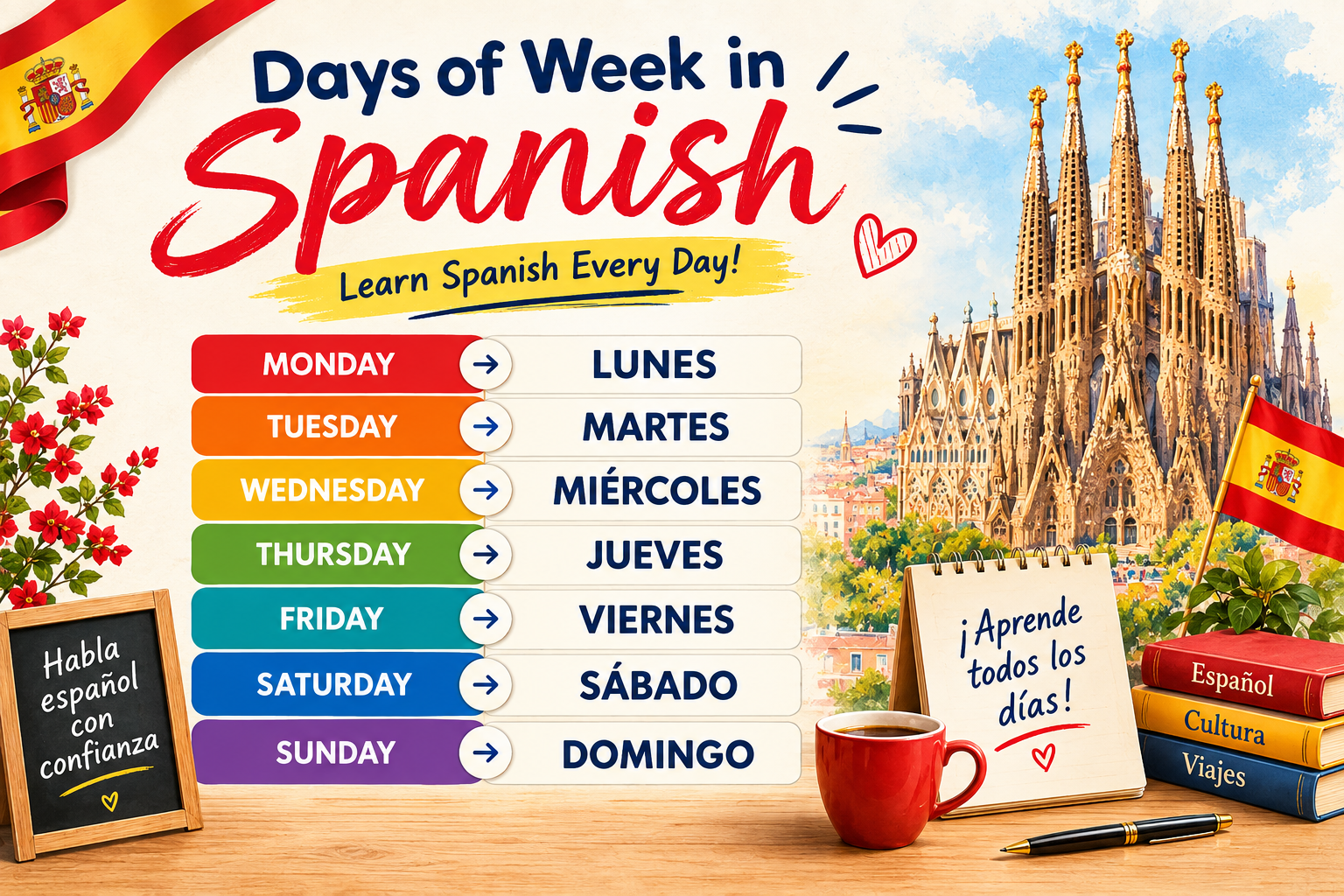
1. Lunes – Monday
Lunes means Monday in English. It is the first day of the working week in many Spanish-speaking countries.
For example:
Hoy es lunes.
Meaning: Today is Monday.
The word lunes comes from the Latin expression associated with the Moon.
2. Martes – Tuesday
Martes means Tuesday. It is the second day of the traditional Spanish working week.
For example:
Mañana es martes.
Meaning: Tomorrow is Tuesday.
The name martes is related to Mars, the Roman god of war.
3. Miércoles – Wednesday
Miércoles means Wednesday in English. Notice that this word contains an accent mark over the é.
For example:
El miércoles tengo una clase de español.
Meaning: I have a Spanish class on Wednesday.
When writing Spanish, remember to include the accent in miércoles.
4. Jueves – Thursday
Jueves means Thursday.
For example:
Nos vemos el jueves.
Meaning: See you on Thursday.
The word jueves is historically connected with Jupiter, the Roman god associated with the planet Jupiter.
5. Viernes – Friday
Viernes means Friday. It is commonly associated with the end of the regular working week.
For example:
El viernes voy al cine.
Meaning: On Friday, I am going to the cinema.
The word viernes is connected with Venus, the Roman goddess of love.
6. Sábado – Saturday
Sábado means Saturday. It also has an accent mark, so make sure to write it as sábado, not sabado.
For example:
El sábado descanso en casa.
Meaning: On Saturday, I rest at home.
7. Domingo – Sunday
Domingo means Sunday in English. It is the final day of the week in the traditional Spanish sequence.
For example:
El domingo visito a mi familia.
Meaning: On Sunday, I visit my family.
How to Use Days of the Week in Spanish
Learning vocabulary is important. However, it is even more useful when you know how to use the words in everyday sentences.
In Spanish, you can use el before a day when talking about something that happens on a particular day.
For example:
El lunes estudio español.
I study Spanish on Monday.
El viernes trabajo desde casa.
I work from home on Friday.
You can also use los when talking about something that happens regularly on a particular day.
For example:
Los lunes estudio español.
I study Spanish on Mondays.
Los domingos voy al parque.
I go to the park on Sundays.
Singular and Plural Forms
Spanish days of the week have a useful feature: most of them do not change in the plural.
For example:
- lunes → lunes
- martes → martes
- miércoles → miércoles
- jueves → jueves
- viernes → viernes
For sábado and domingo, the plural forms are:
- sábado → sábados
- domingo → domingos
Therefore, you can say:
Los lunes tengo clases.
I have classes on Mondays.
Los sábados juego al fútbol.
I play football on Saturdays.
Do Spanish Days of the Week Use Capital Letters?
One important difference between English and Spanish is capitalization.
In English, we normally write:
Monday, Tuesday, Wednesday
However, in Spanish, the days of the week are normally written in lowercase letters:
lunes, martes, miércoles
So, write:
El lunes tengo una reunión.
rather than:
El Lunes tengo una reunión.
This is an important detail for Spanish learners to remember.
How to Say “Today” and “Tomorrow” in Spanish
Once you know the days of the week, you can easily create useful expressions.
| English | Spanish |
|---|---|
| Today | hoy |
| Tomorrow | mañana |
| Yesterday | ayer |
| Today is Monday | Hoy es lunes |
| Tomorrow is Tuesday | Mañana es martes |
| Yesterday was Sunday | Ayer fue domingo |
These expressions are useful in everyday conversations.
Easy Sentences Using Days of the Week
Here are some simple Spanish sentences to help you practice:
- Hoy es lunes. — Today is Monday.
- Mañana es martes. — Tomorrow is Tuesday.
- El miércoles estudio español. — I study Spanish on Wednesday.
- El jueves voy al mercado. — I go to the market on Thursday.
- El viernes trabajo. — I work on Friday.
- El sábado descanso. — I rest on Saturday.
- El domingo visito a mi familia. — I visit my family on Sunday.
A Simple Way to Memorize the Days
A good way to remember the days of the week in Spanish is to practice them in order every day:
lunes → martes → miércoles → jueves → viernes → sábado → domingo
Start by saying them aloud. Then, try writing them without looking at the list. Finally, use each day in a short sentence.
Regular practice will make these words easier to remember.
Conclusion
Learning the days of the week in Spanish is simple and highly useful for beginners. The seven basic words are lunes, martes, miércoles, jueves, viernes, sábado, and domingo.
Remember that Spanish normally uses lowercase letters for the days of the week. Also, pay attention to the accent marks in miércoles and sábado.
Once you know these words, practice using them in sentences about your daily routine, school, work, appointments, and weekend plans. With regular practice, you will quickly become comfortable using Spanish days in everyday conversations.
Frequently Asked Questions About Days of the Week in Spanish
1. How to say Monday in Spanish?
Monday is lunes in Spanish. For example, Hoy es lunes means “Today is Monday.”
2. How to say Tuesday in Spanish?
Tuesday is martes in Spanish. For example, Hoy es martes means “Today is Tuesday.”
3. How to say Wednesday in Spanish?
Wednesday is miércoles in Spanish. The word has an accent mark over the é. For example, Hoy es miércoles means “Today is Wednesday.”
4. How to say Thursday in Spanish?
Thursday is jueves in Spanish. For example, Hoy es jueves means “Today is Thursday.”
5. How to say Friday in Spanish?
Friday is viernes in Spanish. For example, Hoy es viernes means “Today is Friday.”
6. How to say Saturday in Spanish?
Saturday is sábado in Spanish. Remember the accent mark over the á. For example, Hoy es sábado means “Today is Saturday.”
7. How to say Sunday in Spanish?
Sunday is domingo in Spanish. For example, Hoy es domingo means “Today is Sunday.”
8. What are the seven days of the week in Spanish?
The seven days are lunes, martes, miércoles, jueves, viernes, sábado, and domingo.
9. Do Spanish days of the week start with capital letters?
No. Spanish normally uses lowercase letters for days of the week. For example, write lunes, not Lunes.
10. How can I memorize the days of the week in Spanish?
Practice the seven words in order every day: lunes, martes, miércoles, jueves, viernes, sábado, domingo. Then use each word in a simple sentence. Repetition and daily practice can help you remember them faster.
Follow us on Youtube
If you would like to know more Spanish Language