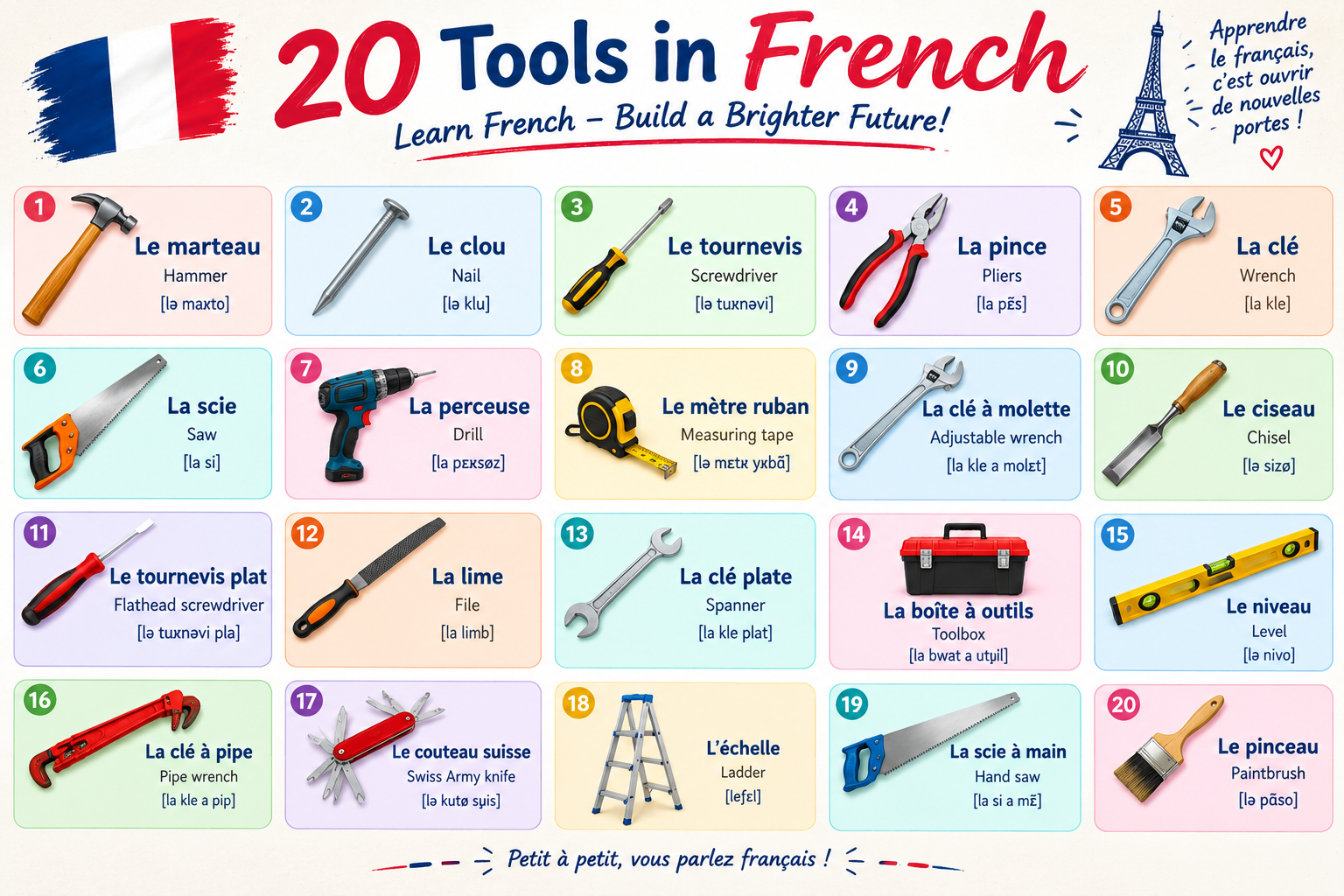
20 Tools Name in French Language
(With Pronunciation and English Translation)
Tools and Toolsbox Vocabulary : in This article you will find a list of French vocabulary words covering tools including hammer, screwdriver, nail, drill machine etc, Half of these tools are borrowed English words wearing a French accent — le cutter is exactly what it sounds like. The other half will make you second-guess everything you thought you knew about French gender, because there’s no visible reason a hammer should be masculine and a wrench feminine. Here are 20 tools you’d actually find in a French hardware store, grouped by type, with pronunciation, English translation, and the handful of patterns that make the vocabulary less random than it looks.
Power Tools — Les outils électriques
Power Tools at a Glance
| English | French | Pronunciation |
|---|---|---|
| Drill | la perceuse | pehr-SUHZ |
| Angle grinder | la meuleuse | muh-LUHZ |
| Jigsaw | la scie sauteuse | see soh-TUHZ |
All three of these end in -euse. Hold onto that detail — it’s about to matter more than it looks like it should.
Hand Tools — Les outils à main
Hand Tools at a Glance
| English | French | Pronunciation |
|---|---|---|
| Hammer | le marteau | mar-TOH |
| Screwdriver | le tournevis | toor-nuh-VEES |
| Pliers | la pince | PANSS |
| Wrench | la clé à molette | kleh ah moh-LET |
| Hand saw | la scie à main | see ah MAN |
| Chisel | le ciseau à bois | see-ZOH ah BWAH |
| Utility knife | le cutter | kew-TAIR |
Two things worth flagging here. Tournevis keeps its final “s” sound, unlike most French words — it’s “toor-nuh-VEES,” not “toor-nuh-VEE.” And ciseau (singular) means chisel, while ciseaux (plural) means scissors — ask a hardware store clerk for des ciseaux and you’ll get pointed at the wrong shelf entirely.
Fasteners and Hardware — La quincaillerie
Fasteners at a Glance
| English | French | Pronunciation |
|---|---|---|
| Nail | le clou | kloo |
| Screw | la vis | vees |
| Bolt | le boulon | boo-LOHN |
| Nut | l’écrou | ay-KROO |
Vis is the other word on this list that breaks the silent-final-consonant rule most French words follow — the “s” is fully pronounced, same as in tournevis.
Measuring, Finishing, and Site Equipment
Measuring and Site Equipment at a Glance
| English | French | Pronunciation |
|---|---|---|
| Tape measure | le mètre ruban | MET-ruh roo-BAHN |
| Spirit level | le niveau à bulle | nee-VOH ah BEWL |
| Sandpaper | le papier de verre | pah-PYAY duh VAIR |
| Staple gun | l’agrafeuse | ah-grah-FUHZ |
| Ladder | l’échelle | ay-SHELL |
| Toolbox | la boîte à outils | BWAHT ah oo-TEE |
Papier de verre translates literally as “glass paper.” Old sandpaper really was coated in crushed glass, and the name outlived the material.
Getting the Grammar and Pronunciation Right
Twenty nouns can feel like twenty genders to memorize. A couple of real patterns cut that down.
Why Every Tool Has a Gender
French doesn’t assign le or la by logic — it’s memorized per word, the same way an English speaker just knows to call a ship “she” without ever learning a rule for it.
A Shortcut for Guessing Le vs La
One pattern actually holds up: nouns ending in -euse are feminine, with almost no exceptions. La perceuse, la meuleuse, la scie sauteuse, and l’agrafeuse — all four tools on this list ending that way are feminine, and that’s not a coincidence. -euse is the feminine form of the -eur/-euse pattern that also turns danser (to dance) into danseur/danseuse.
When the Shortcut Doesn’t Work
It only covers that one ending. Marteau, tournevis, clou, boulon — nothing in how they’re spelled hints at their gender. Those get learned one at a time, as le marteau, le tournevis, and so on.
The One Exception Worth Memorizing
Words starting with a vowel sound — écrou, échelle, agrafeuse — take l’ instead of le or la, regardless of their actual gender. Convenient for speaking, since there’s no gender guess to make in the moment. Inconvenient for learning, since l’écrou gives you no clue that it’s masculine. You’d need to see un écrou somewhere to actually know.
The Sounds That Give English Speakers Trouble
Three patterns repeat across this list. The nasal vowels in pince, boulon, and mètre ruban — pushed out through the nose instead of closed off with a hard “n.” The rounded French “u,” heard in cutter and bulle, which has no real English equivalent; the closest trick is saying “ee” with your lips pushed forward like you’re about to whistle. And that -eu- sound running through every -euse tool, sitting somewhere between the vowel in “fur” and the one in “boot.”
None of that clicks from reading about it. It clicks from saying la perceuse out loud enough times that your mouth remembers the shape on its own.