SEO Title: French Months: Pronunciation & English Translation Guide Meta Description:
Months of the Year in French
(With Pronunciation and English Translation)
French month names are close enough to English that you can guess most of them on sight — octobre, novembre, and décembre aren’t exactly a mystery. The pronunciation is a different story, and so is the grammar around them: French never capitalizes month names, which trips up almost every English speaker’s first attempt at writing a date. Here’s the full list, how to actually say each one, and the rules that make them usable in real sentences.
French Months at a Glance
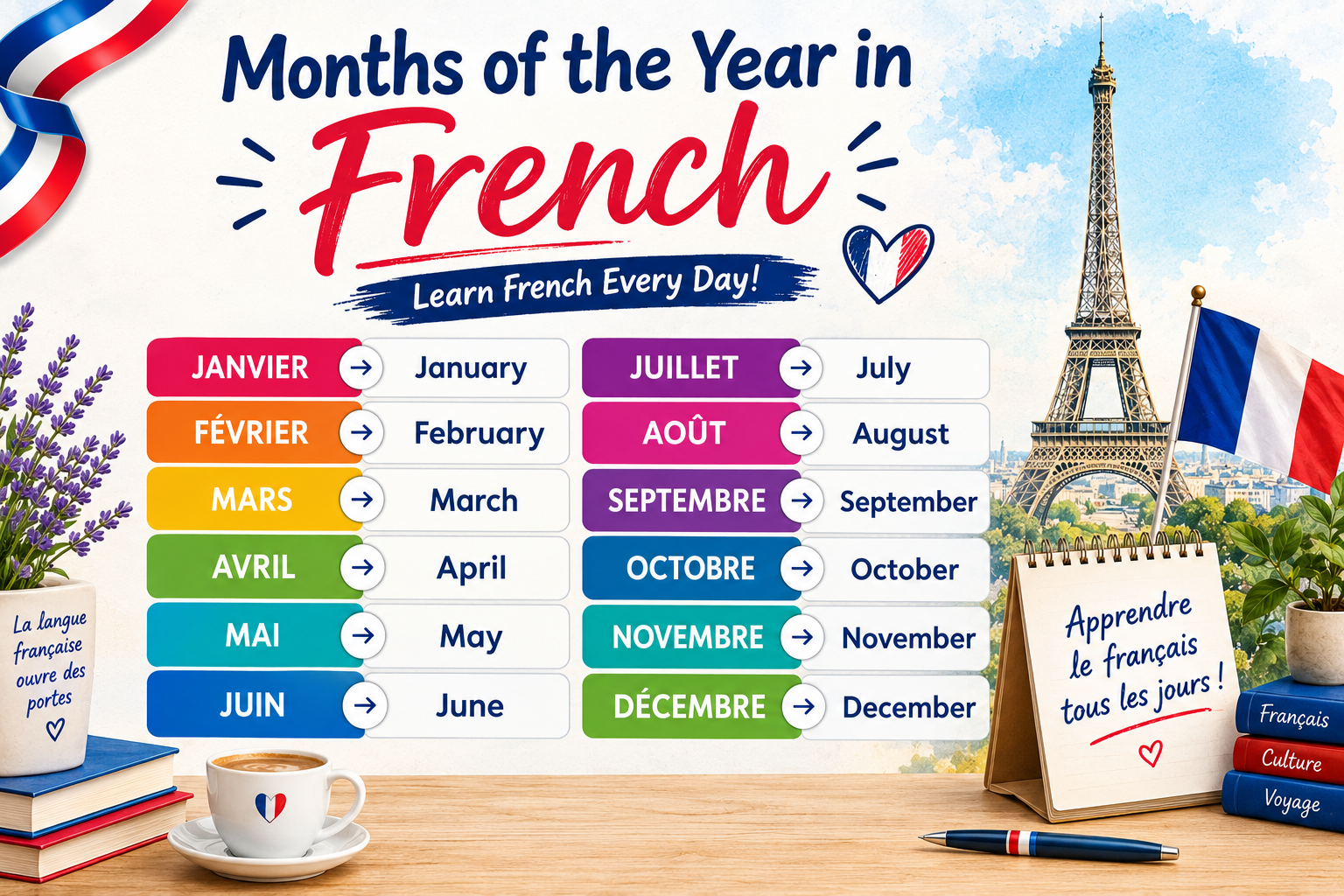
| French | Pronunciation | English |
|---|---|---|
| janvier | zhahn-VYAY | January |
| février | feh-vree-AY | February |
| mars | marss | March |
| avril | ah-VREEL | April |
| mai | meh | May |
| juin | zhwehn | June |
| juillet | zhwee-YEH | July |
| août | oot | August |
| septembre | sep-TAHM-bruh | September |
| octobre | ok-TOH-bruh | October |
| novembre | noh-VAHM-bruh | November |
| décembre | deh-SAHM-bruh | December |
These are simplified English approximations, not strict phonetic notation — close enough to be understood, not close enough to pass for a native speaker on the first try.
Month’s Name In French Video
The Sounds That Actually Trip People Up
Five of these months — janvier, juin, septembre, novembre, décembre — carry a nasal vowel, the sound French makes by pushing air through the nose instead of closing the mouth on an “n” or “m.” English doesn’t have this sound, so it’s the single biggest reason French months sound harder than they look. Say “song” and let it hum through your nose instead of stopping at the “g,” and you’re most of the way to the “-embre” ending in septembre, novembre, and décembre.
Juin is the hardest of the twelve. It squeezes a “w” glide and a nasal vowel into what’s basically one syllable, and even textbooks disagree on how to spell out the sound. The closest shortcut: say “we,” then let the end of it hum through your nose instead of finishing cleanly.
Mars has its own quirk — the final “s” is fully pronounced, unlike most French final consonants, which stay silent. Say it like the English word “mars,” not “mar.”
And août is shorter than it looks. Most French speakers today just say “oo,” dropping the “t” entirely; you’ll occasionally hear it pronounced with the “t” in more formal or older speech, but “oot” as a single syllable will be understood everywhere.
Don’t Capitalize the Months
This is the one rule that catches almost everyone. English capitalizes months — French doesn’t, ever, unless the word happens to start a sentence:
- ✅ Mon anniversaire est en mai. (My birthday is in May.)
- ❌ Mon anniversaire est en Mai.
Same goes for days of the week, for what it’s worth. If you’re used to capitalizing dates in English, expect to catch yourself doing it in French for a while.
How to Say “In March” or “In August”
Use en before most months to mean “in”:
- Il fait très chaud en août à Paris. (It’s very hot in August in Paris.)
- Nous partons en vacances en juillet. (We’re going on vacation in July.)
You’ll also hear au mois de (literally “in the month of”) as an alternative, especially when someone wants to be a bit more precise or formal:
- Nous nous sommes rencontrés au mois de septembre. (We met in the month of September.)
Both are correct — en is just more common in everyday speech.
Writing Full Dates
French dates go day, then month, with cardinal numbers — no “-th” or “-rd” endings to worry about, except for the first of the month:
- le 14 juillet — July 14th (Bastille Day)
- le premier janvier — January 1st (New Year’s Day)
- le 25 décembre — December 25th (Christmas)
Notice premier (first) is the only ordinal number in the bunch. Every other date just uses the plain number: le deux février, le vingt mars, and so on.
Where the Names Actually Come From
The month names are recycled Roman calendar entries, and the history explains a few things that otherwise seem random. Janvier comes from Janus, the two-faced god of doorways and beginnings — a fitting name for the start of the year. Février traces back to februa, a Roman purification ritual held around that time. Mars is named for the god of war, because it was originally the first month of the Roman year, back when military campaigns typically resumed in spring.
Mai likely honors Maia, a goddess linked to growth, and juin honors Juno. Juillet and août are the two months actually renamed after people: juillet for Julius Caesar, and août for his successor, Augustus.
The last four are the most telling. Septembre, octobre, novembre, and décembre come from the Latin words for seven, eight, nine, and ten — septem, octo, novem, decem — because that’s exactly what they were in the old Roman calendar, before January and February got added to the front of the year. September has been the ninth month for over two thousand years, and its name still hasn’t caught up.
Getting the Sounds to Stick
Once the nasal vowels feel natural, the months stop being vocabulary you’re translating and start being just… where you are in the year. Run through the list out loud a few times, and put the extra effort into janvier, juin, septembre, novembre, and décembre — those five nasal sounds are most of what makes this list feel hard, and once they click, the rest is just spelling.